John Phillips Esq. (24 November 1755 – 19 April 1840)
John Phillips is mentioned on a memorial tablet on the wall of the Church of Holy Innocents, Great Barton, which reads ‘John Phillips of Pall Mall, for upwards of half a century surgeon to the Royal Household’.
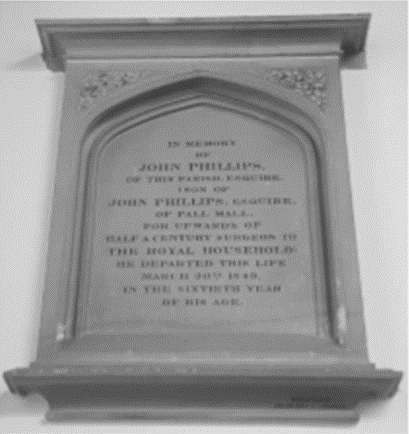
John Phillips was born at Warham St. Mary, Norfolk, and was the son of Robert and Mary Phillips. (https://www.findmypast.co.uk/transcript?id=R_875621472) He had a brother Robert (20 March 1758 – 11 February 1809) and a sister Mary (16 July 1760- 4 March 1849).
The most likely parents were Robert Phillips and Mary Jackson (1734-1800) who were married at East Winch, Norfolk, on 21 January 1755.
On 5 March 1782, John Phillips married Frances Crew (1759 – 11 Jan 1834) at St Martin in the Fields, Westminster, in the presence of Thomas Charles Bunbury (17 May 1740 – 1821) and Margaret Cocksedge (1744 – 14 Feb 1822). At the time of the marriage, John was living in St James, Westminster, and Frances in St Martin in the Fields.
 How was John Phillips connected with Great Barton, and why was Sir Charles Bunbury a witness at his wedding?
Who was Frances Crew?
I have been unable to track down the baptism record for Frances Crew. The following ideas are based on conjecture by Frank Holmes, a well-respected Great Barton historian, who died on 25 September 2018.
In one article, published in Barton Bygones, 1998-2004, Frank claimed that John Phillips was the son of ‘a love-child of the Revd Sir William Bunbury (16 November 1709 – 11 June 1764), born of another vicar’s daughter, whom he adopted. She married Robert Phillips, and their children, including John, were treated as members of the Bunbury household.’ In this version, she is Mary, the mother of John Phillips.
In an article in Great Barton and the Bunburys’, 2009, Frank Holmes wrote that Sir William had a child by the daughter of a vicar friend from London, whom he virtually adopted as his own. She grew up with the boys, eventually marrying a gentleman from Norfolk, Mr John Phillips.’ In this version, she is Frances Crew who married John Phillips.
In a third article, published in Great Barton Village Newsletter, 2018, he stated that ‘The Phillips dynasty started from the daughter of Sir William Bunbury of Mildenhall. She married John Phillips from Norfolk in 1784.’ [This date should clearly be 1782]
In “Great Whelnetham parish registers, 1561 to 1850. Little Whelnetham parish register, 1557 to 1850″ with reference to Henry George Phillips, Vicar of Great Whelnetham, it states that ‘His mother [Frances Crew] was a connection of Sir T. C. Bunbury.’ https://archive.org/stream/greatwhelnethamp15whel/greatwhelnethamp15whel_djvu.txt
This final statement lends credence to the second and third versions, which suggest that Frances Crew was the half sister of Sir (Thomas) Charles Bunbury.
This is further supported by Caroline Mustill (nee Phillips) who states in an email that ‘we have family memoir notes saying that Frances was Sir William’s, by the daughter of a clergyman who subsequently married ‘General Severne of Wallop Hall.’
Sir (Thomas) Charles Bunbury (17 May 1740 – 31 March 1821)
In 1746, William Bunbury, Vicar of Mildenhall, inherited the manors of Mildenhall and Great Barton from Sir Thomas Hanmer (1677-1746), the speaker of the House of Commons from 1714 to 1715, and became the 5th Baronet of Bunbury and Stanney. He married Eleanor Graham (?-22 March 1762) at Higham by Nayland on 16 March 1736 and they had at least five children; Susannah (22 February 1837-?), Thomas Charles, Annabelle (1746-?), William (28 May 1749-?) and Henry William (25 July 1750-1811). Thomas Charles and Henry William were educated at King Edward VI Grammar School at Bury St Edmunds, Westminster School, and St Catherine’s College, Cambridge. Thomas Charles became a Member of Parliament and served in nine British parliaments between 1761 and 1784, and 1790 and 1812. On 25 May 1762, he married Lady Sarah Lennox (1745-1826), a great-granddaughter of King Charles II and the fourth daughter of the 2nd Duke of Richmond and Lennox. In 1764, he became the 6th Baronet of Bunbury and Stanney with properties at Great Barton and Mildenhall in Suffolk, Stanney in Cheshire, and London. In 1776, following the failure of his marriage, a private parliamentary bill was passed, which dissolved their marriage and enabled both parties to remarry.
Sir Charles and the Phillips family
Sir Charles had a long and close relationship with Frances and the Phillips family.
He owned or leased several properties in London, including property at 111 Pall Mall, next door to John Phillips at number 110.
He was married to Margaret Cocksedge (1745-1822) by special licence on 21 November 1805 in the Parsonage at Great Whelnetham, where he was the patron of the parish church. The marriage was officiated by Rev Robert Phillips, who had been instituted as Vicar of Great Whelnetham on 29 September 1788 following the death of Thomas Lord. The witnesses were John, Frances and Mary Phillips (the siblings and sister-in-law of Rev Robert Phillips). Margaret Cocksedge became Dame Margaret Bunbury.
Rev Robert Phillips was educated at Harrow and Christ’s College, Cambridge where he was awarded a BA in 1780. He was appointed as curate of Cranworth, Norfolk, in 1783, Vicar of Carbrooke, Norfolk, from September 1784 to October 1788 and Vicar of Kempston, Norfolk, from September 1786 until his death in 1809. He was also chaplain in ordinary to the Prince of Wales. He died in Pall Mall, London, and was buried at Great Whelnetham, as was his sister Mary.
Sir Charles died childless in 1821. In his original will, written in 1808, the first two pages are devoted to the inheritance of his title and estates by his nephew Sir Henry Edward Bunbury and his descendants. He left 2000 guineas to his wife Margaret and stated his desire that Margaret should be buried alongside his parents and himself at Mildenhall. He next mentioned Frances Phillips to whom he bequeathed £200 in addition to £100 to each of her daughters – Frances, Margaret, Mary and Anne. He then listed bequests to his servants and nephews.
On 18 August 1809, he bequeathed an additional 3,000 guineas to Margaret and 300 guineas each to John Phillips and the sons of John and Frances Phillips – Charles, John , Robert, Henry, Edward.
In a codicil to his will, dated 13 April 1811, he bequeathed the lease of 110, Pall Mall to his wife, together with all the utensils, furniture and pictures with the exception of the painting in his bedroom by Sir Joshua Reynolds, which he gave to Frances Phillips. He also gave small amounts to those servants who had worked for him or at the farm of John Phillips at Great Barton for two years or more.
https://www.ancestry.co.uk/interactive/5111/40611_310363-00278?pid=819877&backurl=https://search.ancestry.co.uk/cgi-bin/sse.dll?indiv%3D1%26dbid%3D5111%26h%3D819877%26tid%3D%26pid%3D%26usePUB%3Dtrue%26_phsrc%3DqjT1265%26_phstart%3DsuccessSource&treeid=&personid=&hintid=&usePUB=true&_phsrc=qjT1265&_phstart=successSource&usePUBJs=true&_ga=2.241647682.1742611184.1567003658-999764159.1551789503#?imageId=40611_310363-00280
Margaret outlived Charles by a year and was buried on 14 February 1822. Sir Henry Bunbury and Frances Phillips were the executors of her will, in which she left money to Sir Henry Edward Bunbury (£1000), her godson Edward Herbert Bunbury (£1000), the two daughters of Sir James Blake of Langham (£200 each), Susanna Adams (£50), John and Frances Phillips (£1000 each), John’s sister Mary (£1000), and various amount to their eight surviving children; Margaret, Mary and Anne £500 each), Charles and John (£1000 each) and Robert, Henry and Edward (£300 each).
https://search.ancestry.co.uk/cgi-bin/sse.dll?indiv=1&dbid=5111&h=418219&tid=&pid=&usePUB=true&_phsrc=qjT1267&_phstart=successSource
John and Frances Phillips
John Phillips served as physician to King George III until 1820, King George IV until 1830, King William IV until 1837 and Queen Victoria until 1840. From 1785, he rented a property at 111, Pall Mall, between Sir Charles Bunbury and George, Prince of Wales (12 August 1762 – 26 June 1830) who, at the age of 18, was given a separate establishment from the King.
John and Frances had 13 children during 20 years, of whom some were baptised at St James, Westminster, and others at Holy Innocents Church, Great Barton. Members of the Bunbury family, including Margaret Bunbury, nee Cocksedge, acted as godparents. Charles, John and Robert attended King Edward VI Grammar School, Bury St Edmunds, as ‘foreigners’, a description given to scholars who lived outside Bury St Edmunds. In 1850, Charles attended the festival at King Edward VI Grammar School.
The fact that the older sons, Charles John (1785) and Henry (1785), did not attend King Edward VI Grammar School and that their names were used for younger siblings may indicate that both boys died in infancy.
Frances died in 1834 at 42, Pall Mall, London, and was buried in the south east chancel vault of Botolph’s Church, Shenley, Hertfordshire. John died three years later and asked in his will that he should be buried alongside his wife. However, the chancel and tower arch were pulled down after a fire in 1753. John’s will made bequests to all of his surviving children and left his medical books and surgical instruments to Charles, and his estate and West Farm, Great Barton, to John who was already managing the farm.
A. The children of John Phillips and Frances Crew
1) Frances (26 December 1783 – 1809)
2) Charles John (22 January 1785 – bef. 1822)
3) Henry (14 December 1785 – bef. 1822)
4) Margaret Mary (1 April 1787 – after 1822)
5) Charles Henry Phillips (14 Mar 1788 – 8 August 1863)
6) John Phillips (21 Aug 1789 to 10 March 1849)
7) Robert Fryer (3 October 1790 – 6 February 1856)
8) Henry George (2 October 1791 – 29 July 1873)
9) James Joseph (11 February 1793 – bef. 1822)
10) Mary Elizabeth (22 November 1794- 1823)
11) Anne (26 September 1796 – after 1822)
12) Edward Francis (7 February 1798 – 1839) described as living in Malta in 1837, died at Chelsea.
13) William (21 May 1803 – before 1822).
5) Charles Henry Phillips (14 Mar 1788 – 8 August 1863) was appointed Assistant Surgeon to the Grenadier Guards on 16 June 1808. He served with them during the Battle of Corunna (1809), for which he was mentioned in dispatches; took part in the unsuccessful Walcheren expedition to the Netherlands (1809) and was with them in Spain at the Battle of Barrosa (1811), part of an unsuccessful manoeuvre to break the siege of Cádiz in Spain during the Peninsular War, during which a single British division defeated two French divisions and captured a regimental eagle. He returned with the wounded to Spithead, was awarded a medal and retired from the Army.
On 18 July 1811, he was appointed Surgeon to the Marylebone Infirmary and on 15 May 1812, qualified as a Member of the Royal College of Surgeons. He was subsequently employed as Surgeon Extraordinary to King William IV until he succeeded his father as Surgeon to the Royal Household on 23 April 1840 to (The London and Provincial Medical Directories, 1845-1942).
Queen Victoria always referred to him as ‘Boy Charles’ following an incident during the 1830s when a lady-in-waiting was taken sick and Charles’s father had said, ‘I will send the boy Charles round.’ The Queen declared that so long as there was a member of the medical profession in the Phillips family, he should be appointed to the Royal Court (Frank Holmes, Barton Bygones). On 11 December 1843, Charles qualified as a Fellow of the Royal College of Surgeons and was one of the original 300 Fellows (https://livesonline.rcseng.ac.uk/).
Charles married Charlotte Bunce (2 October 1790 – 1867) on 12 September 1811, at St James, Westminster. In 1851 and 1861 they lived at 6 Trafalgar Square, Fulham Road, Chelsea. In 1851, they lived with their children Emma (1830-?), Henry (1833-?) who was a solicitors clerk, and their grandson Charles (1842-?) who was a scholar. In 1861, they lived with their son Francis (1836-?) who was a Civil Servant and their grand children, Charlotte (1841-?) and Charles (1842-?).
Charles died in 1863 and left effects valued at under £800.
6) John Phillips (21 Aug 1789 to 10 March 1849) married Mary Elizabeth South (1802 – 23 September 1825), the daughter of John South, at All Saints Church, Huntingdon, on 8 October 1824. Mary died soon after the birth of her only child, John South Phillips (8 September 1825 – 3 July 1890) and was buried in the churchyard of Holy Innocents Church, Great Barton.
Under the terms of his father’s will in 1837, John was bequeathed West Farm, Great Barton, (also known as Phillips Farm) and was expected to support his 80-year-old aunt, Mary Phillips, and enable her to live at the farm.
In 1816, there was a case of suspected arson at Phillip’s Farm, Great Barton (Bury and Norwich Post, 17 April 1816).

In 1844, there was another fire at Phillips’ Farm, but this time there was no mention of arson.
A most destructive fire took place on Wednesday night on a farm, the property and the occupation of Mr. John Phillips, Great Barton. It was discovered about quarter past seven o’clock, and express was immediately sent off to Bury St. Edmunds for the fire-engines, which soon after arrived, but owing to the deficient supply of water, were unable to render any material service. The property destroyed consisted of a large barn, in which was coombs of wheat and 200 coombs of oats, which had been got up about week ; row of cart sheds and other outbuildings, a waggon, and quantity of agricultural implements. The property was insured (Globe, 14 September 1844).[1 coomb = ½ a quarter or 4 bushells]
There are several other references to John Phillips in the Bury and Norwich Post.
On Saturday last Robert Bishop, servant of John Phillips, Esq. of Great Barton, was convicted before Chas. Blomfield, Esq. in the penalty of 10s. on the information of the Rev. Edward Hogg, for driving his waggon improperly on the highway (Bury and Norwich Post, 31 May 1820).
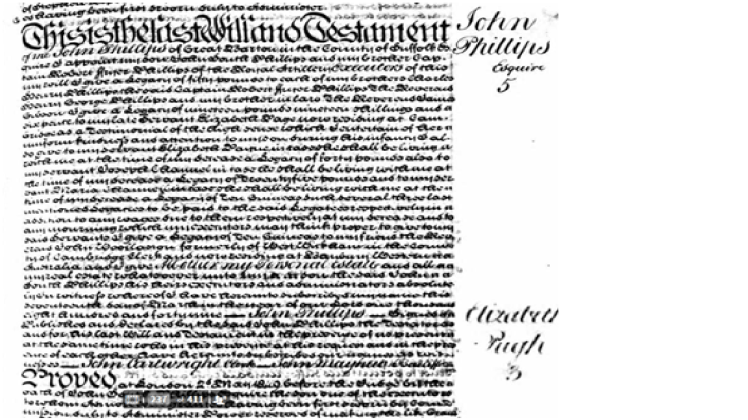
John was buried with his wife and there is a memorial tablet to John on the wall of Great Barton Church, which mentions his father. In his will, he left money to his servants but bequeathed his estate and personal belongings to his son, John South Phillips (England & Wales, Prerogative Court of Canterbury Wills, 1384-1858).
7) Robert Fryer Phillips (3 October 1790 – 6 February 1856) joined the Royal Artillery in 1806 and took part in the Walcheren expedition, 1809, and the Peninsular War, 1812 to 1813. He married Harriette Rantzan Hamilton Martin (1797-1871) on 13 March 1828 at Clapham, was promoted to Brevet-Major in 1854 and died at Bath two years later.
8) Henry George Phillips (2 October 1791 – 29 July 1873) matriculated from Charterhouse in 1810 and was awarded a BA in 1814 and a MA in 1817 from Emanuel College, Cambridge. He was ordained as a deacon on 8 January 1815 and was instituted as Vicar of Mildenhall by Sir Charles Bunbury on 5 May 1818 (Bury and Norwich Post, 06 May 1818), having already been instituted as Rector of Great Whelnetham under the patronage of Sir Charles on 27 February 1816.
On 18 May 1819, he was married at Newington, Surrey, to Frances Thomas (1792 – 17 June 1852), the fourth daughter of Captain Thomas of Dover Place, Kent Road. They lived at the Rectory, Great Whelnetham, and had at least six daughters and one son. In 1870, their son, Robert, wrote a letter from India to his father describing a tiger hunt in great detail (Bury Free Press, 29 April 1871). Henry and his wife were buried at Great Whelnetham.
B. The family of John South Phillips
John South Phillips (8 September 1825 – 3 July 1890) attended King Edward VI Grammar School from 1836 until 1843. He boarded with the Revd J.E. Kempe, won prizes for ‘hexameters’ and ‘Greek iambics’ and became the School Captain. At Trinity College, Cambridge, he was the coxswain of a very successful rowing team and in 1847 was awarded the title of ‘Head of River’. In 1848, he was awarded a B.A. as Jurist Optime and 2nd Class Classics, and in 1852 a M.A.
In 1849, just after the death of his father, he married his first wife, Mary Anna Charlotte Heigham (1824 – 6 February 1859), the daughter of John Henry Heigham of Hunston Hall.
They lived in Great Barton and in the 1851 census, their farm was named ‘Mr Phillips Farm’, and John was described as the occupier and part owner of a 544-acre farm, which employed 22 men and 10 boys. In the 1861 Census and 1871 Census the farm was not given a name, but in the 1881 Census was called The Lodge. In the electoral registers of 1865 and 1870, it was called West Farm and was described as a freehold house and land.
John had four children with Mary Anna, but she died soon after the birth of her fourth child, Mary Grace F. Mary Anna was buried in a grave in the churchyard at Holy innocents Church, Great Barton, alongside that of her baby daughter.
Two years after the death of his first wife, John South Phillips married Eliza Caroline Oakes (15 September 1835 – 19 February 1922), who was born in Rougham and was the daughter of Elizabeth Charlotte and the Revd Hervey Aston Adamson Oakes, Rector of Nowton, Suffolk. They had four children.
John was appointed as a Justice of the Peace in 1857, Deputy Lieutenant of Suffolk in April 1877, and a governor of King Edward VI Grammar School, Bury St Edmunds, in 1879. He was also the Captain of the 13th Suffolk Rifle Volunteers. On the birth certificates of his children, he was described as a ‘gentleman’.
In 1859, John South Phillips was one of the 18 Great Barton electors in the West Suffolk Constituency, but he chose not to exercise his vote.
In 1863, in his role as a JP, he and other Great Barton dignitaries wrote to John Henry Borton Esq, the Clerk of the Peace for the County of Suffolk requiring him to give notice of the holding of General or Quarter Sessions, where a proposal would be made to dissolve the Highway District of Blackbourne under The Act for the Better Management of Highways in England, 1862 (Bury and Norwich Post, 20 October 1863).
In 1868, he did exercise his vote and voted for Major Windsor Parker (Conservative) and Lord Augustus H.C. Hervey (Conservative) whilst the majority of the electors in Great Barton voted for Charles Lamport Esq. (Liberal). Both Conservative candidates were elected, but nationally a Liberal Party government, led by William Ewart Gladstone (1809-1898), was elected (Sue Spiller, Bertuna’s Children, (Arena Books, 2017) page 40.
In 1871, the family employed a cook, parlour maid, house maid and kitchen maid. None of the servants came from Great Barton and it was common practice at this time not to employ servants from the local area. Employers believed that, not only would it be more difficult for the girls to return home if they were homesick or unhappy, but also there would be less likelihood of trouble from the girls’ suitors, or of the private affairs of their employers being discussed in the locality.
In 1885, John South Phillips wrote a letter to the local paper about the plight of agricultural labourers:-
PEASANT PROPRIETARY. Sir, — We are being ruined by theories and theoretic Government. This is Mr. Chamberlain’s last utterance. “Here are so many thousand acres out of cultivation, and so many thousand men out of work ; bring the men to the acres and the problem of England’s difficulties is solved.” This is a taking theory, but in fact an absurdity. To bring a man to five acres of land, and say to him, ” Arise, Peter, till and eat,” is a most cruel mockery. It is obvious he must have at least £40 in his pocket to accept the situation. Seed, implements, and some stock must be bought; and he must then live from six to 12 months waiting for his produce. How is this to be done? But, suppose he started, how is he to get on if his produce does not pay to grow; and even if you were to give him a pig it would not pay to fatten ? Mr. Bright and Mr. Chamberlain may be good manufacturers, but when the former talks of one hare per acre being of no consequence and the latter advances his recent theories they exemplify the truth of the proverb that the “cobbler should not go beyond his last”. I speak from practical experience in an arable county. A beneficent landlord in this village has made the experiment ; he has given one of the best, most industrious, and sober labourers a few acres to cultivate at a reasonable rent, and in a very few years the good man, sadder and poorer, has asked to be relieved of his burden. Lord Tollemache’s benevolent efforts have, I believe, been made in a grass county, which is beside the question. I have no doubt that in Cheshire, if the poor man has five acres assigned him, and can afford £20 for a cow, he will do fairly well provided there is someone to keep a bull for him and head a subscription when the cow dies (Morning Post, 04 February 1885).
In 1886, John South Phillips was foreman of the jury at an inquest held at the Crown Beer House, Great Barton, before Mr. R. H. Wilson, coroner for the liberty of Bury St. Edmunds. The inquest concerned the death of John Dorling, the head teacher of Great Barton Boys’ School, who committed suicide, ‘whilst in a state of temporary insanity, by cutting his throat with a razor’ (Bury and Norwich Post, 4 May 1886). (Sue Spiller, Bertuna’s Children (Arena press, 2017) pages 340-341).
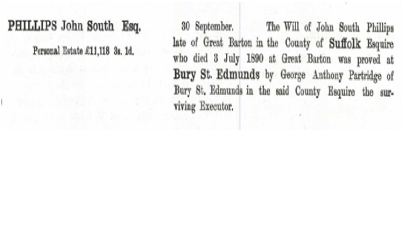
John South Phillips died in 1890 and was buried in the graveyard at Holy Innocents, Great Barton, on 7 July 1890, leaving an estate valued at £11,118. 3s. 1d.
Of the eight children of John South Phillips, his three sons became Vicars, one daughter almost married a vicar and another daughter did marry a Vicar. There was no-one to take over the farm in Great Barton so the farm stock was sold by direction of the executors at a sale, prior to which there was a dinner at the Griffin Inn, Ingham, attended by Sir Henry Bunbury and many other distinguished people who had known him.
Eliza Caroline Oakes Phillips (15 September 1835 – 19 February 1922) moved to The Elms, 7 High Street, Ixworth, with her three oldest children.
This 15-room house had recently been vacated by the Revd Thomas Herbert Bindley (21 October 1861 – 11 March 1931), who had lived there since before 1889 when his daughter Mildred Duncombe (12 September 1889 – 1983) was born (Morning Post, 16 September 1889). Thomas Bindley sold his furniture by auction on Tuesday 19 August 1890 and moved to Barbados to take up the post of Vice-Principal of Codrington College, Barbados, and the Examining Chaplain to the Bishop of Barbados and Windward Islands (Manchester Courier And Lancashire General Advertiser, 30 August 1890). A few months after his arrival, his son Herbert Duncombe (8 February 1891 – 6 May 1967) was born. By 1911, the Revd Thomas Bindley had returned to Suffolk and was living in the Rectory at Hedenham, Bungay, with his wife and daughter, whilst their son, Herbert, was living in Trinidad and Tobago, to where he had sailed on 9 November 1910.
In 1891, the Phillips family employed a living-in cook, parlour maid and gardener. Eliza South Phillips and her daughters took an active interest the affairs of St Mary the Virgin’s Church, Ixworth.
On 14 June 1913, this notice appeared in the local paper ‘ Ixworth High Street properties. The Elms, white brick & slate, secluded grounds, occupied by Mrs South Phillips, yearly tenant at £30. ‘
Eliza died in 1922, leaving her effects valued at £1,570. 12s. 6d. and was buried alongside her husband at Great Barton. According to a newspaper report of her death, Eliza was of a ‘kind and warm hearted disposition, was ever ready to support charitable objects and ready to lend a helping hand to those in need’ (Bury Free Press, 25 February 1922).
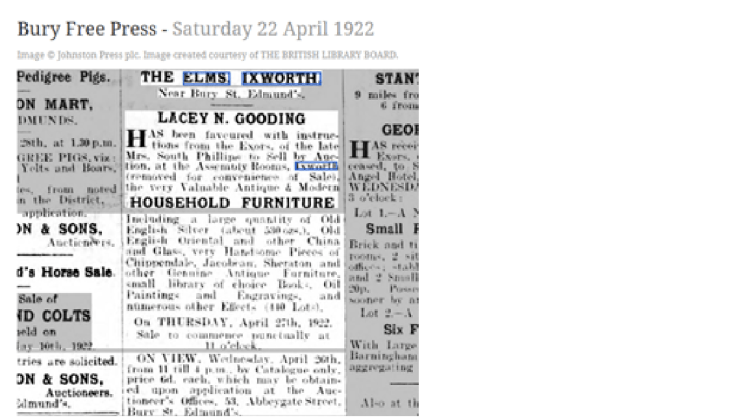
Both of her daughters continued to live at The Elms and two months after Eliza’s death, held an auction at The Pickerel of 440 items from the Elms, including furniture, silver, china, books and paintings.
The children of John South Phillips
1) Agnes Maria Desburgh (7 April 1850- 26 January 1940);
2) John William Heigham (21 November 1851 – 10 September 1894);
3) Maud Mary Gould (January 1853 – 16 February 1932);
4) Mary Grace F (1859-1859) who died soon after at birth.
5) Elwin George Wilson (April 1862 – 24 February 1941);
6) Ethel Mary Desborough (1865 – June 1940);
7) Alexander Robert South (5 June 1867 – 13 February 1953).
8) Mabel Charlotte Oakes (April 1870 – 11 December 1957).
1) Agnes Maria Desburgh Phillips (7 April 1850- 26 January 1940) and her sister Maud were educated at home by a governess; a role filled in 1861 by Matilda Oppertunies (1836-?) from Porto Rico.
In 1887, Agnes married the Revd Alfred Edward Gover (15 October 1853 – 28 August 1932), born in Taunton, Somerset, who was employed as Rector of Carlton with Willingham, near Newmarket, Suffolk, from 1881 to 1924.
Their only son, Clement Edward John (16 January 1891 – 2 March 1969), was educated at Charterhouse School, Pembroke College and Wells Theological College. He was ordained in 1914 and held curacies at St George’s, Wigan, and Holy Trinity, Ilfracombe. From 1917 to 1920 he was a temporary Royal Army Chaplain to HM Forces and served in Mesopotamia with the 1/6th Devons Marine Expeditionary Force. He moved back to Devon and in 1921, married Margaret K. Macmichael (5 September 1897 -?), the daughter of the Vicar of Lee, at Barnstable. He was the Vicar of Ilfracombe (1920 to 1924), Ottery St Mary (1924 to 1925), Broadhembury (1925 to 1935), Tipton St John, Sidmouth (1935 to 1941) and St David’s Exeter (31 January 1941 to ?).
After Alfred’s retirement in 1924, Alfred and Agnes moved in with their son. Alfred died in 1932 and was buried in the churchyard of St Andrews Church, Broadhembury. He left gross effects, valued at £11,022. 15s. 6d., and bequeathed £50. to his gardener, Henry Smith.
Agnes continued to live with Clement and was described as ‘incapacitated’ in the 1939 census. She died a year later at the age of 90 and bequeathed the sum of £2,550. 10s. 3d., updated to £2,736. 11s. 11d., to Clement.
Clement died at Middle Beer, Brithem Bottom, in 1969 leaving two sons and effects valued at £18,365.
2) John William Heigham Phillips (21 November 1851 – 10 September 1894) was baptised at Holy Innocents Church, Great Barton, on 6 January 1852. He attended King Edward VI Grammar School as a boarder before going to Trinity College, Cambridge, where he was awarded a BA in 1874. He was ordained as a deacon at Ely in 1874 and as a priest in 1875 and ministered in the Church of All Saints, Huntingdon, from 1874 to 1877.
At a congregation held at Cambridge, ‘the Revd John Heigham Phillips, Curate of Wavendon, Beds, eldest son of John South Phillips, Esq., was admitted to the degree of Master of Arts’ (Bury and Norwich Post, 08 May 1877). [NB At Cambridge, the MA is conferred by right on holders of the BA degree of the University and on certain other senior members and is an academic rank, not available as a postgraduate qualification.]
John was employed as rector at Wavendon, Bucks, (1877 to 1880) and Little Whelnetham, Suffolk, (1880-1894). On 22 January 1880, he married Frances Elizabeth Browne, the daughter of a physician, in the parish church of St Marylebone, London, and they had two daughters: Frances Alice H (1881- ?) and Gertrude Ethel M (1885- ?). John was vice chair of the Board of Guardians and Secretary of Horningsheath Rural Deanery. He suffered from a lung disease and was on sick leave at Great Yarmouth when he died at the age of 44. He was buried at Whelnetham.
3) Maud Mary Gould Phillips (January 1853 – 16 February 1932) left home during the 1880s and lived on her own means in two rooms in a lodging house in Clarkson Street, Ipswich, from 1881 until at least 1911, but her last place of residence was 13 Quilter Road, Felixstowe. She left effects valued at £1510. 15s. 3d., which were administered by her nephew, the Revd Clement Gover.
At her funeral it was said that she had devoted many years of her life to work amongst the poor, more particularly in the parish of St. Matthew’s, Ipswich, (Bury Free Press, 27 February 1932).
5) Elwin George Wilson (April 1862 – 24 February 1941) was baptised at Holy Innocents Church, Great Barton, on 1 June 1862. He became an articled clerk to a solicitor at the age of 18 and lived at home at Great Barton and Ixworth until his marriage to Helen Frances Perry (July 1865 – 9 September 1925) at St George, Hanover Square, London, in October 1891. She was the daughter of Sir Thomas Erskine Perry, Chief Justice of Bombay and Member of Parliament for Devonport. Elwin and Helen moved to Richmond Cottage, Uley, Gloucestershire, and then to the Manor House at Little Bealings, Suffolk, in about 1910. Helen was ‘an invalid for many years, but retained her interest in life and bore her sufferings uncomplainingly and patiently’ (Bury Free Press, 12 September 1925). She was buried in the churchyard of Holy Innocents Church, Great Barton.
Elwin remained living at Little Bealings and shared the house with 14 others in 1939. At his funeral it was said that he was ‘well known for his interest and sympathy with the working class’ (Bury Free Press, 08 March 1941). He died two years later at Heigham Hall, Norwich, a private mental hospital, and was buried alongside his wife at Great Barton on 27 February 1941.
6) Ethel Mary Desborough (1865 – June 1940) was described as an invalid in the 1939 census and died a year later at the age of 75, leaving effects valued at £118. 1s. 4d.She was buried in the churchyard at holy Innocents Church, Great Barton.
7) Alexander Robert South Phillips (5 June 1867 – 13 February 1953) passed the examination for seniors at All Saints School, Bloxham (Bury Free Press, 14 March 1885), graduated from Selwyn College, Cambridge, in 1888 and was employed as an assistant master at Framlingham College, Suffolk, to teach general subjects. Alexander took Holy Orders in 1892 and was ordained at Ely. He became curate of Brampton, Huntingdonshire, under his father-in-law and was a cricketer, a rower, a marksman and a footballer. In 1895, he became the Curate of Hale, Farnham, Surrey.
In July 1901, he married Evelyn Mary Linton Budge (14 May 1874 – 1942) who was from St Neots, Huntingdon, and was the daughter of the Revd Henry Simcoe Budge, the rector of Brampton, Huntingdonshire. Alexander was employed as the Rector of Fromevanchurch, Dorset, from 1901 to 1912, living in the 12-room rectory with one general servant. He combined his experience as a teacher with his work in the church by becoming assistant diocesan inspector of schools from 1905 until his death.
In 1912, Alexander was presented to Eynesbury Rectory, St Neots, by the Earl of Sandwich and served there for 28 years. He and his wife lived in Eynesbury Rectory, Saint Marys Street, St Neots, with at least three servants. He oversaw improvements to Eynesbury Church and was Rural Dean of St. Neots from 1924 to 1929 and honorary Canon of Ely in 1931. He was a keen gardener and sportsman, member of the St. Neots Rural Council, and chaplain of the Euston Lodge of Freemasons. In 1917 he addressed a meeting of the Mothers Union in Ixworth (Bury Free Press, 22 September 1917).
He retired in 1940 and moved to Great Paxton Vicarage, not far from Eynesbury. From 1940, he worked as a curate, assisting the Vicar of Little Paxton and Toseland and the Revd Budge, who was his brother-in-law (Bury Free Press, 27 July 1940). On 27 February 1953, the Diss Express announced the death of Canon ARS Phillips of St Neots.
8) Mabel Charlotte Oakes Phillips (April 1870 – 11 December 1957) was a very active churchgoer whose duties included taking care of the altar and sanctuary at St Mary the Virgin’s Church, Ixworth.
On 30 June 1891, in the same column as the announcement of her brother, Elwin’s forthcoming wedding, the following notice appeared in the Bury and Norwich Post. ‘A marriage has been arranged and will shortly take place between the Rev. F. D. Perrott, Vicar of Ixworth, Bury St. Edmund’s, and Mabel, daughter of the late Mr. John South Phillips, of Great Barton, near Bury St. Edmunds.’
The man in question was the Rev Frank Duerdin Perrott (12 September 1858 – 5 December 1936) and on 11 August 1891, Mabel and Frank performed a violin and piano duet in a concert at a bazaar, held at Little Haugh Hall, to raise money for the restoration of Norton Church.
The Rev. Frank Perrott championed the rights of agricultural labourers and in January 1892 read a paper at the Parish Room, Ixworth, on “The Housing of the Working Classes Bill.” (Bury and Norwich Post, 05 January 1892). He stood as a candidate for West Suffolk County Council and was elected to represent Ixworth (Suffolk and Essex Free Press, 09 March 1892).
He resigned his living on grounds of ill health and executed a Deed of Relinquishment in order to regain the civil rights he lost through ordination. (E.A. Livingstone (editor), The Concise Oxford Dictionary of the Christian Church (OUP 2006). He availed himself of funding from the Clerical Disabilities Act 1870 to qualify as a barrister and work in London. He became a resident of the University Hall Settlement, London, and a member of the Inner Temple and was admitted to the Bar in June 1899.
Under the Clerical Disabilities Act 1870, ‘clergy of the C of E who resigned their preferment could execute a Deed of Relinquishment and thereby regain such civil rights as they lost through ordination’. E.A. Livingstone (editor), The Concise Oxford Dictionary of the Christian Church (OUP 2006).
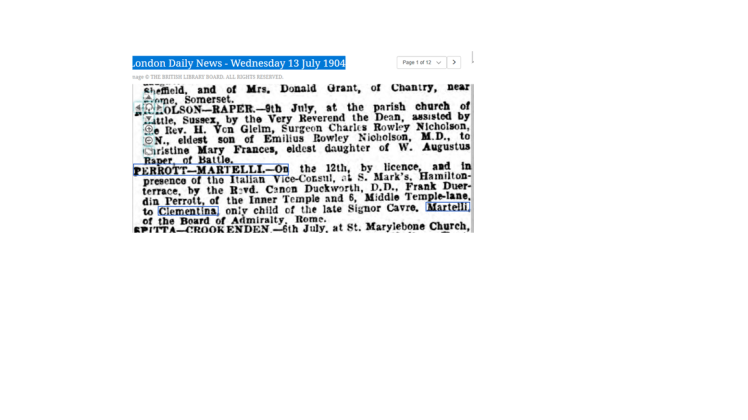
On 12 July 1904, Frank married Clementina Martelli (1872-?), an Italian lady, at St John’s Wood, London. In 1911, Frank was lodging in Brighton, Sussex, without Clementina and was employed as a barrister in a motor practice.
Mabel sang and played the violin in fund-raising concerts at Great Barton Boys’ School, including one in aid of the Society for the Prevention of Cruelty to Children (Bury Free Press, 14 January 1893), one to set up a fund to provide cassocks and surplices for the choir which had recently expanded to include 24 choristers (Bury Free Press, 12 February 1898), a Christmas entertainment (Bury Free Press, 10 December 1898) and one organised by the Missionary Society, where members also heard a talk about life in Madagascar (Bury Free Press, 20 April 1901).
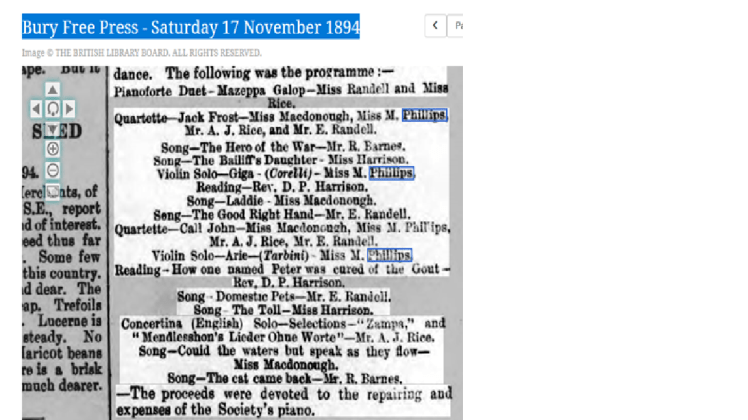
In 1894, she performed for Ixworth Choral Society where the proceeds were devoted to the repairing and expenses of the Society’s piano (Bury Free Press, 17 November 1894).
She contributed to a sale of work at Thurston (Bury Free Press, 10 June 1911) and later that year, at the Annual Festival of the Ixworth Branch of the Girls’ Friendly Society, was presented with a ciborium (drinking cup) for Ixworth Church ‘in memory of Eleanor Neate, who had worked hard to promote the work of the society’ (Bury Free Press, 09 September 1911). In 1917, she was responsible for the decoration of the font during a harvest festival. In 1919, she attended the dedication service of Ixworth Memorial Lych Gate, a beautiful building at the entrance to the new cemetery, away from St Mary’s Church (Bury Free Press, 9 August 1919).
In perusing the columns of the Bury Free Press, it is evident that Mabel attended many funerals including those of wealthy families in Suffolk and local people in Ixworth.
These included Major Heigham of Hunston Hall, Chief Constable of Suffolk (1898) Mrs Betts of Great Barton (1912), Mrs Moore (mother of headmaster of Pakenham School) (1914), Mary Argent (1914), Major Clement John Malcolm Heigham, JP, of Hunston Hall (1915), John Seymour of Ixworth House (1916), Laura Blackall of Ixworth (1919), Melinda Kate Brook of 127 Northgate Street, Bury St Edmunds, who died by drowning (1929), Agatha Royds Trevor, daughter of Sir Walter Green of Nether Hall (1933), H. Balaam (1935), Alice Lord of the High Street, Ixworth, who was knocked over by a runaway car (1938), Mr Theobald of High Street, Ixworth (1938) and William Durrant (1945).
At Great Barton she followed the Suffolk Foxhounds (Bury Free Press, 07 November 1891), attended the induction of the Revd Lipscombe at Holy Innocents Church, Great Barton, (Bury Free Press, 24 July 1915) and the unveiling and dedication of a memorial to William Norman King (Bury Free Press, 06 October 1923).
In 1939, she and Ethel still lived at the Elms, Ixworth, but without any living-in help. Mabel died 18 years later at Red House Nursing Home, Kilverstone, Thetford, at the age of 87 and left effects, valued at £7,827. 5s. 11d. She was buried alongside her sister, Ethel.
Afterword
One of the descendants of the Phillips family is Nicholas (Nick) Addison Phillips, Baron Phillips of Worth Matravers, born in 1938 in Buckinghamshire to Michael Phillips and Dora Hassid who were married in Oxfordshire in 1936. Nick Phillips is a former President of the Supreme Court of the United Kingdom and, when Master of the Rolls, he carried a copy of Magna Carta at the ceremony in Bury St Edmunds, not knowing of his connection with Great Barton. He subsequently took an interest in both the village and the history of his family.
There are no traces of the Phillips family in Ixworth since neither Mabel nor Ethel had any children and both were buried at Great Barton. However, the memory of Mabel was recalled in ‘History of Ixworth during the 1920s and 1930s’ by Frank Bean, which mentioned that ‘A lady who took a keen interest in the parish was Miss South Phillips living at the Elms in High Street and was ever busy with many tasks particularly concerning the Church’ (The Ixworth Magazine Celebrates the 50th Anniversary of the Jiggens Memorial Hall, 1981).
I am indebted to
https://www.ancestry.co.uk/ , https://www.findmypast.co.uk/FamilyHistory and https://www.britishnewspaperarchive.co.uk/ for much of the information about the family history of the Phillips family
 BERTUNA'S CHILDREN
Caroline Clarinda Townsend (1766 to 1851) left £100 to “Charles Phillips esquire surgeon now residing in London … he is son to my old friend Mrs Phillips”.
Caroline was the daughter of Thomas Townsend, steward to Earl Spencer. She lived in St James Westminster (very near Spencer House) for decades but at some point removed to Southampton.
LikeLike