The origin of the name Holden comes from the Old English term ‘hol’ meaning hollow or sunken and ‘denu’ meaning valley.
In 1891, the majority of people with the surname Holden lived in Lancashire, but during the nineteenth century, there were several Holden families in Suffolk including John Holden (1775-1865), a yeoman farmer, and some of his descendants, who lived in Great Barton.
Most of the information is derived from http:// ancestry.co.uk, which was last accessed in 2017. I have not purchased any birth, marriage or death certificates, which could verify and add a great deal of detail to this basic information.
I have made every effort to check the content for accuracy and to interpret data correctly and, to the best of my knowledge all details are accurate at the time of publication. However, new information is regularly coming to light, some of which could add to, or even contradict, previous knowledge, and I apologise if anything I have written, based on the best evidence available at the time, proves to be inaccurate in the future.
A number in square brackets after the name of an individual e.g. Anna Brand [588] indicates the registration number of their record in the burial register of Holy Innocents’ Church, Great Barton.
Copies of the burial register are held:-
- at the record office in Bury St Edmunds, where it is on the open shelves as 929 342 644 BAR (Transcripts from Great Barton Church Burial Registers 1563-1992);
- in Holy Innocents’ Church, Great Barton, accessed via the church wardens.
John Holden (1775 – 1865) and Harriet Hynard (1775 – 1851)
John Holden was born in Hepworth, Suffolk, in 1775 to James Holden (1746 – 16 April 1829) and Sarah Willison (1749 – 1839). James and Sarah had 10 sons and 3 daughters and lived in Hepworth all their lives.
John was baptised on 25 July 1775 and was the oldest child. He married Harriet Hynard from Great Barton on 11 November 1798, moved to Great Barton and had at least three children.
In 1841, they rented a 46-acre farm on Fornham Road, Great Barton, from the Bunbury family.
In 1853, there was a burglary at the farm. ‘William Robinson, aged 18, was charged with having stolen from the house of Mr. John Holden, of Great Barton, two great coats, and other articles. The prosecutor is a farmer. On the morning of the 19th of January, he, together with his housekeeper, left the premises all safe at twelve [o’clock]. Upon their return at three [o’clock], they found that the robbery had been effected. The prisoner was apprehended at Thetford, where he had offered the stolen articles for sale. [He was found] guilty: Six months hard labour, and to be once whipped. Thomas Turner, of Cambridge, gave the prisoner a good character, and said that he had been groom in the employ of Lord Euston and Mr. Hope, and that he should be perfectly willing to take him into his employ again’ (Bury and Norwich Press, 23 March 1853).
Harriet died on 23 July 1851 at the age of 75 [279]. By 1861, John was retired and blind. He lived with Martha Smith, a 63-year-old servant in Fornham Road, next door to his daughter Mary, who took over Fornham Road Farm with her husband, Robert Bishop.
John died on 16 March 1865 [279] and his will, published on 12 April 1865, stated that he left ‘effects under £450’.
The farmhouse at Fornham Road Farm was built of brick and tiled in slate. In 1915 it comprised two sitting rooms, a kitchen, scullery and dairy downstairs, and three bedrooms and two box rooms upstairs. There was a bake-house, washhouse, earth closet and small garden outside.
By 1915, Fornham Road Farm had increased to 81 acres, of which 55 acres were arable and 19 acres were grass. James Maulkin King, JP, a director of Greene King Brewery in Bury St Edmunds, who lived at Barton Lodge, rented 64 of the acres from the Barton Estate.
In 1915, Rutters in Bury St Edmunds, who traded property from 1890 and are now William H. Brown estate agents, bought 31 acres of the farm at the sale of the Barton Estate on behalf of James Maulkin King for £2,070. Sadly, James Maulkin King suffered from advancing paralysis and was found dead in his bathroom on 15 January 1917, having shot himself in the head with a revolver (BFP, 20 Jan. 1917). He left effects valued at £220,839. 4s.6d.
Fornham Road Farm was eventually bought by the Long family who incorporated it into Hall Farm, Fornham St Martin. The farmhouse is currently in private ownership.
Children of John Holden (1775-1865) and Harriet Hynard (1775-1851)
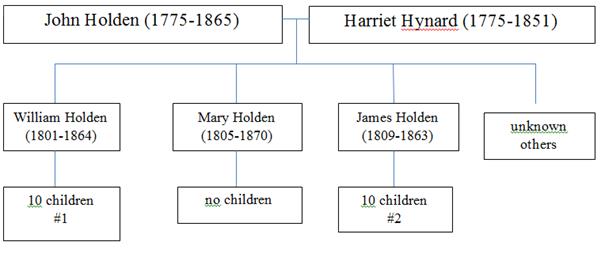
William Holden (1801 – 1864) [280] was baptised on 25 November 1801 in Great Barton. On 6 March 1827, he married Mary Pawsey (1805 – 1893) [280] from Great Barton and they had 10 children (see below #1) during the following 22 years. They farmed a 52-acre farm in Livermere Road, Great Barton, with the help of two employees. By 1864, William was severely depressed and committed suicide by cutting his throat (Bury and Norwich Press, 10 May 1864). Mary continued to manage the farm for a few more years but by 1881, had moved with her daughter, Susan, to a house in School Road, Great Barton, and died in 1893.
Mary Holden (23 June 1805-1870) [25] married Robert Bishop (11 Dec 1796-1886) [249]. In 1851, they lived in Fornham Road and their nine-year-old niece, Mary Holden, a daughter of William Holden, was with them on the night of the census. Mary and Robert had no children. Robert worked as a dealer in 1851, but after John Holden retired, Robert managed the farm on Fornham Road. In 1871, Robert Bishop was living with Ellen (b.1826) from Thurston, who was listed as his wife, his 23-year-old niece, Charlotte Holden, who was another daughter of William Holden, and 17-year-old Joseph Long, who was a servant. By 1881, Robert had retired and lived in School Road with John Reeve, who was a ‘greengrocer’s attendant’, and Charlotte who was his housekeeper.
James Holden (1809 – 6 October 1863) married Elizabeth Pollintine (1808 – 12 February 1871) from Great Barton on 31 December 1835. James and Elizabeth moved to 69, Guildhall Street, Bury St Edmunds, and ran the Black Boy Inn. They had ten children (see below #2), none of whom were listed as scholars in the 1851 census. James died leaving ‘effects under £800’ and Elizabeth died eight years later, leaving ‘effects under £1,500’.
#1 Children of William Holden (1801-1864) and Mary Pawsey (1805-1893)
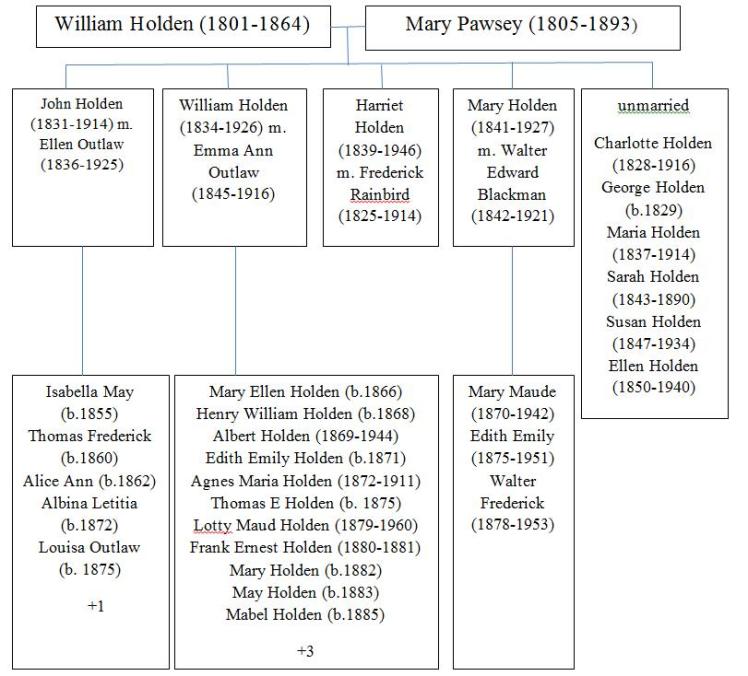 William and Mary had three sons (George, John and William), seven daughters (Charlotte, Maria, Harriet, Mary, Sarah, Susan and Ellen) and 20 grandchildren. Five of the children lived to their 80s; one lived to the age of almost 90 and another to the age of 107! Six remained single and, of the two daughters who married, one had three children (one of whom became a teacher), the other had none. One of the sons who married had 14 children, one of whom became a teacher, and the other son had three children, two of whom became teachers.
1a) Charlotte Holden (1828-1916) [589] worked as a housemaid for the Vicar of Beyton at Beyton House in 1851 but was living at home in 1861 with her parents, sister Ellen and brother William, at the farm in Livermere Road. In 1871, she lived with her uncle and aunt, Robert and Mary Bishop, who ran the farm in Fornham Road, originally owned by her grandfather, John. In 1881, she moved with Robert to School Road, next door to her mother and sister, Susan, and worked as his housekeeper. After the death of her uncle, she moved in with her mother and sister, by which time she had lost her hearing. After her mother died on 1 May 1893, Charlotte and Susan continued to live in the house in School Road, and Charlotte received an old age pension from 1909.
1b) George Holden (b.1829) was staying with his grandparents, John and Harriet in 1851. I have not found him in the 1861 census and, at the inquest of his father’s death in 1864, George’s brother, William, was reported as saying ‘five years ago my eldest brother left his home and has never been heard of’ (Bury and Norwich Post, 10 May 1864).
1c) John Holden (1831-1914) married Ellen Outlaw (1836 – 18 March 1925) from Pakenham in 1854 and worked as a gamekeeper all his life. They had seven children including Isabella Mary (b.1855), Thomas Frederick (b.1860), Alice Ann (b.1862), Ellen Elizabeth (b.1867), Albina Letitia (b.October 1872) and Louisa Outlaw (b.1875).
They lived at Mildenhall at first, where Isabella Mary (b.1855) was born, and then moved to Caldy, Cheshire where Thomas Frederick (b.1860) was born. Ellen’s sister, Emma, who later married John’s brother William, visited them there on the night of the 1861 census. Alice Ann (b.1862) was born in Great Barton, and Ellen Elizabeth (b.1867) and Albina Letitia (b. October 1872) were born at Easton, Lincolnshire. By 1875, they had moved to the Front Lodge at the gates of Prestwold Hall, where Louisa Outlaw (b.1875) was born and they lived for the next 36 or more years. In 1881, Thomas, Alice, Ellen and Louisa lived at home and Thomas worked as a valet at the Hall. On the day of the 1881 census, Isabella and Albina were staying with their aunt, Eliza Canvin, who lived at Home Farm in Wicken, Northamptonshire. Eliza was married to Daniel Canvin, who ran a 306-acre farm, and worked as a lace-maker, as did most of the women in her village at that time. In 1891, Ellen, Albina and Louisa lived at home with their parents – Ellen was a schoolmistress; Albina was a mothers’ help and Louisa was a dressmaker’s apprentice. On the day of the 1901 census, Ellen was staying at Derby with her daughter, Ellen Eliza, who was married to a mechanical engineer and no longer worked as a teacher. Albina lived at home with her parents at Prestwold and worked as a dressmaker until at least 1911.
John retired during the 1900s and died in Loughborough in 1914 and Ellen died twelve years later at 27, Arthur Street, Loughborough, leaving £142. 18s. 6d. in her will to Isabella, who was unmarried.
Ellen Outlaw (1836 – 18 March 1925) was the daughter of Thomas Outlaw (1800 – 1875), born in Pakenham, and Mary Jacob (1803 – ?), born in London, who married on 13 August 1821. Ellen had three brothers and six sisters including Emma who married William Holden, the brother of Ellen’s husband, John. In 1851, her father worked as a market gardener and lived in a cottage near Red Castle Farm, Pakenham, a 244-acre farm, which employed nine men, owned by Robert Jacob (1770-1851) who lived in Red Castle Farmhouse, which stood within a large three-sided moat.
1d) William Holden (1834- 26 May 1926) lived at home and worked on the farm at Livermere Road until 1865, when he married Emma Anne Outlaw (1845- 21 March 1916) a younger sister of Ellen, who was married to William’s brother, John. In 1871, they lived at Puttock’s Hill, Pakenham, next door to Red Castle Farm, and William worked as a farm bailiff. By 1871, they had three children and by 1881 had moved to an eight-roomed farmhouse at Oak Tree Farm, Norton Little Green, a 50-acre mixed farm, which William farmed with the help of ‘one man and two boys’. According to the 1911 census, William was deaf. He and Emma had 14 children (see below #3). Emma died in 1916 but her will was not published until 1926 when William died. Emma left £265 to Edwin Charles Lanyon and Isabella Turner (the wife of William Turner). William left £481. 6s. 6d to Edwin Charles Lanyon and Lotty Maud Tuck, his daughter.
Edwin Charles Lanyon (1870-1946) lived in Norton from 1903 and was described in Kelly’s Directory for Suffolk in 1912, 1916 and 1925 as the village schoolmaster and assistant overseer. Norton School was a mixed school, which had been set up in 1836 for 170 children. There were 130 pupils in 1912 and 156 in 1916 and 1925, according to Kelly’s Directory for Suffolk for those years. Edwin who was born in St Allen in Cornwall and married Florence Burton (b.1870) on 20 August 1895, at St Andrew by the Wardrobe in the City of London. His oldest daughter, Florence (b.1897), born in Devon, attended County School in Bury St Edmunds. Josiah (b.1903) and Amelia (b.1907) were born at Norton. Josiah became a civil engineer. Edwin died at Strathclyde Nursing Home at Boscombe, Hampshire and left £7,806. 9s.11d. to Josiah and Florence.
1e) Maria Holden (1837-1914) worked as a servant for John Pace, a silversmith, in 1851 and lived at 14, Abbeygate Street, Bury St Edmunds. In 1861, she was a maid at Hatfield Place, Hatfield Peverel, for William Tufnell, a magistrate and landowner. In 1881, she was a lady’s maid for Sophia Stewart, a 70-year-old annuitant, who lived at 6, Northwick Terrace, Marylebone. By 1891, she was the matron at the Digby Institute, in Post Office Road, Bournemouth, set up by the Young Women’s Christian Association as the result of a growing interest in the welfare of young women at work and the dangers to which they were exposed on leaving home. She managed a 55-roomed hostel with up to 70 residents, whose occupants included teachers, dressmaker, waitresses, shop assistants and secretaries. She still worked there in 1911.
1f) Harriet Holden (14 March 1839 – 17 November 1946) worked at South Weald Vicarage before her marriage in 1860 to Frederick Rainbird (1825-1914), a 34-year-old widower, who had three children, Daniel (b1848), Eliza (b1850) and Thomas (b1852). Frederick’s father, Daniel (b1796) owned a small bricklaying company in South Weald, Essex, and Frederick and his brother, Thomas, worked with him as bricklayers and lived in adjacent cottages in Coxtie Green. Frederick continued to work until he was in his 70s and, when he died in 1914, left £1,891. 4s. 3d. to his sons, Daniel and Thomas, who were also bricklayers. Rainbird Group Ltd still operated as builders in Brentwood in 2017.
Harriet, known as ‘Granny Rainbird’, moved in with Eliza, her stepdaughter, who lived at Pleasant Cottages, Coxtie Green. She lived to the age of 107. In 1939, a report in the local paper stated ‘LADY CENTENARIAN. On Tuesday, Mrs. Harriett Rainbird, of Coxtie Green, celebrated her 100th birthday. Mrs. Rainbird was born at Great Barton, Bury St. Edmunds. At the age of 17 she was a domestic servant at South Weald Vicarage, and has lived in the Brentwood district ever since. She married in 1860, and her husband died 25 years ago, since when she has resided with her stepdaughter, Mrs. King, at Coxtie Green. Mrs. Rainbird is in good health, and can read with the aid of glasses, her only incapacity being slight deafness. She has not been out of doors for some months, but is accustomed to going out in good weather. Mrs Rainbird said she considered the secret of long life and good health was hard work and a contented mind. Many congratulations were received, and a royal telegram of greeting. A birthday cake was presented by members of the large Rainbird family.’ (Chelmsford Chronicle, 17 March 1939).
Her birthday was reported in the local paper each year.
In 1940, ‘Mrs Harriet Rainbird is remarkably bright, and until a year or so ago attended St. Paul’s Church, Bentley. Hard work and contentment is her recipe for long life. Owing the death on the previous day of her only surviving sister, who was nearly 90, Mrs. Rainbird kept her birthday quietly’ (Chelmsford Chronicle, 16 March 1940).
In 1944, ‘Mrs. Harriet Rainbird celebrated her 105th birthday on Tuesday with three hearty meals and an afternoon nap. She keeps in close touch with the war news, listens every evening to the radio, and is certain she will live long enough to see Hitler dead and buried (Chelmsford Chronicle, 17 March 1944).
In 1946, ‘Mrs Harriet Rainbird was 107 yesterday. She has lived to see her greatest ambition realised – Hitler dead and buried’ (Chelmsford Chronicle, 15 March 1946).
Harriet died on 17 November 1946, leaving £2,179 (net £2,065) (Chelmsford Chronicle, 14 March 1947).
1g) Mary Holden (April 1841- 30 July 1927) was staying with her uncle and aunt, Robert and Mary Bishop on the night of the 1851 census at the farm in Fornham Road, originally owned by her grandfather, John. In 1861, at the age of 19, she was a pupil teacher at the Charles Bunbury School, Mildenhall, where she assisted Louisa Scott, the schoolmistress. In 1869, she married Walter Edward Blackman (1842 -13 November 1921) who was the son of a farm labourer from Bishops Waltham, Hampshire. They moved to Great Dunmow, where they both worked as schoolteachers and Walter was the church organist. They lived in a house in the Causeway, took in a boarder, Maria Price, who was also a teacher, employed a servant and had a daughter Mary Maude (1870-1942). During the early 1870s, they moved to Long Buckby, Northamptonshire, where they lived in the Schoolmaster’s House and worked at the Great Chequer Government School, next door to the Five Bells Public House. Walter was the master of the boy’s school with 158 boys; Mary Maude was the mistress of the girl’s school with 135 girls. Two more children, Edith Emily (1875 – 3 October 1951) and Walter Frederick (06 July 1878 – 02 August 1953) were born and the family continued to employ a housemaid.
Walter Edward Blackman died in 1921 leaving £4,866. 7s. 3d. to Maude and Walter Frederick. Mary died six years later at The Laurels, Long Buckby, at the age of 87, bequeathing £297. 9s. 5d to Edith Emily.
Walter Frederick Blackman ( 1878-1953) married Lizzie Matilda Parker (1882 – 1 October 1964), the daughter of Thomas Edward Packer, who was born in Long Buckby. They married at the parish church at East Haddon, Northamptonshire, on 4 June 1906, at which time Walter lived at Bulwell and was a corn dealer. In 1911, Walter was described as a corn merchant and grocer. He and Lizzie lived in a six-roomed house at 179, Quarry Rd, Bulwell, Nottingham, with one-year-old Walter, three-year-old Mary and a general servant. By 19 February 1916, they were living at 26, Albert Street, Bury St Edmunds, when he enlisted for the Army Service Corps on a Short Service Attestation. He described himself as a ‘corn and seed merchant’. Walter Frederick died in 1953 at Bonnville Manor, Lea Road, Milford, Surrey, leaving £1,708 14s. 1d. Lizzie died 11 years later at 13, Berkeley Square, Warblington, Hampshire, leaving £2,049.
Mary Maude Blackman (1870-1942) worked at the District Commercial Travellers School for Orphan and Necessitous Children at Pinner, Middlesex, in 1891, which employed 11 teachers and a head teacher. In 1901, Mary Maude lived at home in Church Street, Long Buckby and taught at a private school. By 1911, she was the head teacher of a private boarding school at 90, Heaton Moor Road, Heaton Moor, Stockport, Cheshire, where she and her sister, Edith Emily, and two other teachers, aged 21 and 23 taught eight female pupils, aged 11 to 17. A housekeeper, housemaid and general servant were also employed. Mary Maude died at Bridge, Kent. Edith Emily left £3,209. 11s. 3d. to her niece and nephew – Walter Edward Blackman, a shop manager, and Edith Mary Blackman.
Edith Emily Blackman (1875 – 3 October 1951) taught at the District Commercial Travellers School for Orphan and Necessitous Children at Pinner, Middlesex in 1901, at which time it employed 13 teachers and a head teacher. In 1911, she taught at the private boarding school run by her sister Mary Maude.
1h) Sarah Holden (1843-1890) [301] worked as a servant at Little Livermere for John Cutting, a farmer, and then at Botesdale, Suffolk, as a cook for James Hustler, a magistrate, from the age of 21. She died at Botesdale in 1890 in tragic circumstances that were reported in the local paper. ‘BOTESDALE. Suicide of a cook – Sarah Holden, aged about 50 years, who was on Thursday morning found drowned in a pond near the Lodge, the residence of Mr. J. D. Hustler, J.P. Deceased was cook at Mr. Hustler’s, in whose service she had been for about 26 years. She was missed on Wednesday afternoon, and search was made for her. Dr. Pearce, who had attended the deceased professionally, said she suffered from delusions, one being that she had poisoned someone. A verdict of suicide whilst of unsound mind was returned’ (Bury Free Press, 9 August 1890).
1i) Susan Holden (1847-1934) [765] worked as a servant for Edward Limmer, a miller, at Beyton in 1861. After the death of her father, she moved back to the farm in Livermere Road with her mother. During the 1870s, Susan and her mother moved to 2, School Road where Susan lived until at least 1911 and worked as a dressmaker.
1j) Ellen Holden (1850 – 13 March 1940) lived to the age of nearly 90. In 1871, she worked as a kitchen maid for Bevan Beckford at 8, Northgate Street, Bury St Edmunds, and for over 20 years as a servant at Pikehurst, Chiddingfold, owned by John Ryde, who employed between seven and nine servants. John Ryde was a wealthy man, who died in 1919 leaving £81,270. 10s. 7d. to his widow Marion Louisa (1867-1935). Ellen died twenty-one years later in Bury St Edmunds.
#2 Children of James Holden (1809 -1863) and Elizabeth Pollintine (1808-1871)
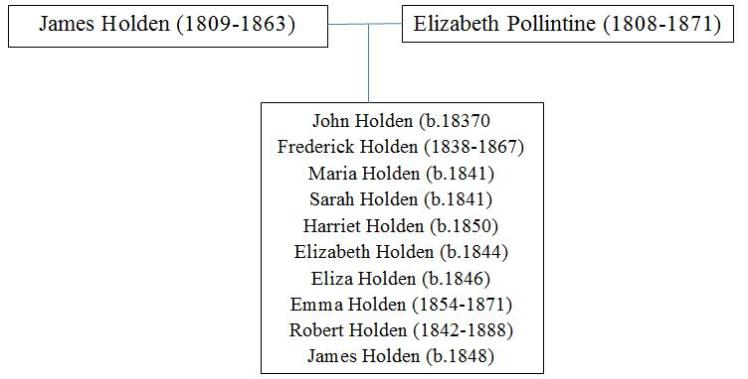 James and Elizabeth Holden had four sons and six daughters, all of whom were born in Bury St Edmunds, Suffolk.
2a) John Holden (b.1837) lived at home with his family at the Black Boy Inn, Bury St Edmunds, in 1851. I cannot find any further information.
2b) Frederick Holden (14 April 1838-2 February 1867) joined the Royal Navy as an engineer on 25 May 1860, by which time he was married. He sailed to the West Indies on HMS Desperate, serving as Acting Third Class Assistant Engineer, and then Acting Second Class Assistant Engineer. He sailed on HMS Colossus on 6 June 1864, and then as Acting First Class Assistant on HMS Princess Royal, a second-rate ship with 91 guns, on which there had been an alleged mutiny in November 1859. Frederick became a rifleman in 11 July 1866 and sailed to Hong Kong, which had become a ‘crown territory’ in 1842. He died there in February 1867.
2c) Maria Holden and 2d) Sarah Holden were twins who were born in January 1841. In 1861, Maria was a domestic servant in Northgate Street, Bury St Edmunds, for Frederick Sutton, a former captain in the 11 Hussars. Sarah was a servant for the Curate of Great Whelnetham, Suffolk, who was born in Calcutta, India.
2e) Harriet Holden (b.1850) was also a servant for the Curate of Great Whelnetham, Suffolk, in 1861, although she was only ten-years-old. In 1871 and 1881, she lived with her brother Robert and his family at 68, Guildhall Street, Bury St Edmunds. After Robert’s death in 1888, she moved to 54, Churchgate Street, and lived with her nieces, Agnes and Edith, who were daughters of Robert, both of whom worked as draper’s assistants.
2f) Elizabeth Holden (b.1844) was a servant in Bury St Edmunds for George Clay, a wine merchant, in 1861.
2g) Eliza Holden (b.1846) was a servant at 8, Queen Street, Hanover Square, London for Harriet Ashworth, a ‘fundholder’, in 1861.
2h) Emma Holden (1854-1871) lived at home until she was 15. When she was 14-years-old, her parents applied for her to be admitted to the Eastern Counties’ Asylum for Idiots at Essex Hall, Colchester, which had been set up in 1859 to provide facilities for local mentally handicapped patients, mainly children. It served Essex, Norfolk, Suffolk, and Cambridgeshire and was the second such institution to be set up in England. It was funded by voluntary subscriptions and contributions from some patients, and no paupers were admitted. There were 66 inmates in 1862. Suitable candidates were sponsored by local worthies and elected by subscribers. In August 1868, there were 37 candidates for eight places and although Emma polled 2,842 votes, she came tenth (Bury Free Press, 08 August 1868). She stood again in January 1969 with eight other candidates and came first with 6,497 votes (Bury Free Press, 30 January 1869). Patients were accepted for five years and, from 1865, up to 20 per cent of cases could be re-selected to give them a permanent home.
Most of those admitted were children and the asylum provided some education and training. ‘Higher grade’ patients were taught reading, writing and arithmetic or learned tailoring, housework, gardening and laundry work. Recreational activities included sports such as cricket football and croquet, looking after animals and watching magic lantern shows.
Emma was admitted to the asylum on 25 November 1869 and died there on 1 October 1871.
2i) Robert Holden (1842 – 30 November 1888) married Mary Elizabeth Borrett (1843 – 1882) from Topcroft, Norfolk, on 27 December 1866. They lived at 68, Guildhall Street, Bury St Edmunds, next door to the Black Boy Inn, and Robert worked as a corn merchant. Robert’s sister, Harriet, described as an annuitant, lived with them in 1871 and 1881. Robert and Mary had five children: – Hubert Walter (b.1870), Ernest (b.1871), Charles Alfred (b.1872), Agnes Emma (b.1874) and Edith Bessie (b.1875). In 1881, they employed a servant. When Robert died in 1888, he left a personal estate of £2,637. 2s. 6d.
2j) James Holden (b.1848) lived at the Black Boy Inn until his parents died and the pub had new owners. In 1871, he lived in a multi-occupied house with six rooms at 5, Sidmouth Street, St Pancras, which was shared by 15 people and was a mechanical engineer.
#3 Children of William Holden (1834-1926) and Emma Outlaw (1845-1916)
According to the 1911 census, William and Emma had 14 children but I have only found the names of 11 of them. They were all born in Suffolk. Mary Ellen at Great Barton; Henry William, Albert, Edith Emily, Agnes Maria and Thomas at Pakenham. Lotty Maud, Frank Ernest, Mary, May and Mabel at Norton.
3a) Mary Ellen Holden (Nelly) (b.1866) was born in Great Barton. In 1892, she married Charles Robert Cook (b.1869), who came from Yoxford, Suffolk. Charles was a grocer’s assistant and they had ten children during the following 11 years. Mary Ellen’s parents brought up their son, Thomas (b.1893), who helped on their farm in 1911.
They moved from Norton to 30, Victoria Road, Great Berkhamstead, in 1899 and Charles was a grocer’s assistant. Between 1907 and 1911, they moved to a seven-roomed house on the Market Square at Winslow, Buckinghamshire, where Charles worked as a grocer’s assistant and two of the children worked as carpenter’s apprentices.
3b) Henry William Holden (Harry) (b.1868) was staying with his aunt Susan at Great Barton on the night of the 1871 census. In 1899, he married Harriet (b. 1873) from Cropwell Butler, Nottinghamshire, and they lived at Pakenham, where Henry worked as a family butcher. By 1911, they had three children:- Mabel (b.1901), Susan (b.1903) and William (b.1909).
3c) Albert Holden (1869-1944) married Adelaide Swan (b.1869), who was born in St James, Piccadilly, London. Their marriage was solemnized on 26 April 1890 in the House of HRM Embassy at Paris, with the consent of HM Ambassador, in the presence of a chaplain (RG 33: Foreign Registers and Returns, 1627-1960). In 1891, they lived at Linton, Cambridgeshire, where Albert worked as a journeyman blacksmith, and in 1901 at Pakenham, where Albert worked as a blacksmith.
3d) Edith Emily Holden (b. 1871) lived at home until the 1890s.
3e) Agnes Maria Holden (July 1871- April 1911) lived at 5, Meat Market in Abbeygate, Bury St Edmunds, in 1891 and worked for Charles Felton, a draper, as a dressmaker. She never married and died at Thetford.
3f) Thomas E Holden (b.1875) worked as a butcher in 1891 with his brother Henry. In 1903, he married Maggie (b.1883) from Worksop, Nottinghamshire, and in 1911, they lived in the eight-roomed farmhouse at Oak Tree Farm, Norton Little Green, where Thomas worked on the farm with his father.
3g) Lotty Maud Holden (1879 – June 1960) married George North Tuck (1878 – December 1966) from Bury St Edmunds in 1907 and they moved to Stowlangtoft, which had a population of 158 in 1901. In 1911, they lived in six rooms at Stowlangtoft Post and Telegraph Office with George’s 71-year-old aunt Ellen and a post office assistant. George was the sub postmaster, grocer and stationer until at least 1925. Lotty worked as a schoolteacher in 1901 and 1911, although she was not mentioned in Kelly’s Directory for Suffolk as a teacher at the school at Stowlangtoft, which had been built in 1894 for 70 pupils, but had an average attendance of 35 pupils in 1912 and would have only employed one teacher, who was Mrs Ada J. Angood in 1916. However, she may have been an assistant teacher at Norton School, which had 130 pupils in 1912 and was about a mile away.
3h) Frank Ernest Holden (1880-1881) died soon after birth.
3i) Mary Holden (b.1882) was described in the census as ‘feeble-minded’ and still lived at home in 1911.
3j) May Holden (b.1883) lived at home in 1911 and helped her mother.
3k) Mabel Holden (b.1885) lived at home in 1901 and worked as a dressmaker.
published 09 May 2017
 BERTUNA'S CHILDREN