Sybil Constance Alexandra Mackenzie (28 October 1872 – 12 February 1954) was the granddaughter of Colonel Alexander Mackenzie (1761 – 12 July 1831), who was apparently, “a most distinguished soldier. He served with the 36th Regiment throughout the Peninsular War and, in the course of his service, was dangerously wounded in the neck, lost an eye, and had two horses killed under him. He was a gallant and distinguished officer; in every sense a thorough Highlander.” [i]
Colonel Alexander Mackenzie had two children with his first wife, Eliza, daughter of Colonel George Mackenzie, and six more, including Sybil’s father, with his second wife, Eliza Muirhead Graeme (1797-1837), daughter of Captain James Graeme, R.N.
Sybil’s father, Alexander MacKay Mackenzie (10 March 1825 – 27 May 1879), was born at Saint Leonards, Streatham, and baptised at St Leonards Church, Streatham, on 16 July 1825. Although he was the third son, he became the 7th representative of the Gruinard, Ross-Shire, branch of the Mackenzie clan.
He entered the army in 1842 and had a meteoric career. He was promoted to captain in 1857, major in 1862, lieutenant colonel in 1868, colonel in December 1873 and retired major general on 25 November 1874. He served against the insurgents in Bundelkund from 1843 to 1844 and commanded the 8th Irregular Cavalry, which had been set up in 1842 and raised by Europeans from volunteers who owned their own horse and equipment and were prepared to provide for themselves in the field. On 31 May 1857, he commanded his troop during the Indian Mutiny of native troops at Bareilly, and he aided in the rescue of 48 Christian refugees, who had been sheltered by friendly Hindus at Rohilkund in the Uttar Pradesh state of India. He served during the siege of Lucknow, the first of which lasted 87 days and the second a further 61. Lucknow was eventually captured and all fighting had ceased by 21 March 1858. (Illustrated London News, 07 June 1879) (Naval & Military Gazette and Weekly Chronicle of the United Service, 04 June 1879).

In 1867, he married (Louise) Marion Frances Colville (1835 – 3 January 1923) who was born at Baylham, near Great Blakenham, Suffolk, to Louisa Marianne Susan Frances Kelso and the Revd William Colville, Vicar of St Peter’s Church, Baylham, where she was baptised on 10 November 1835. After their marriage, Marion and Alexander lived in India, where Lilias Marion Louise (22 March 1869 – 18 April 1945) was born in Kawarich, Rajputon, and John Colville Alexander Gruinard (1 Jan. 1871 – 17 March 1907) in Bengal.
In 1872, Alexander and Marion returned to the UK with Lilias and John and lived at 40, Queensborough Terrace, Paddington, Kensington, where they had two more children. Sybil Constance Alexandra was born in Paddington and baptised at Lancaster Gate, Christ Church, Paddington, on 12 March 1873. Stuart Kelso Graeme (4 August 1877 – 1942) was born in Paddington and baptised at St Mary’s Church, Bryanston Square, Marylebone on 28 November 1877.
Alexander died in London on 21 May 1879 and a sketch of his career appeared in Celtic Magazine, vol. IV., pp. 321-327. He left a personal estate of under £4,000, and was buried in Kensal Green Cemetery.
Marion continued to live at Queensborough Terrace, Paddington, and from 1889 to 1905 registered as an occupation elector, eligible to vote in county and borough council elections.
In the census of 1881, Marion, whose occupation was described as ‘income from dividends’, lived with Lilias, Sybil and Stuart and employed a cook, nurse, housemaid and under nurse. Her son, John, was at a boarding school in Ipswich. Her butler, Edward John Snelling, worked for her for 30 years. Although he married Mary in 1880, the 1881 census included him amongst the occupants of Queensborough Terrace. Edward and Mary had four children between 1881 and 1888 and lived in Pimlico, Kensington and Chelsea during t880s, Willesden in 1901 and Ealing in 1911. In 1881, Marion’s son, John, was at boarding school in Norwich Road, Ipswich.
At the time of the census in 1891, Lilias, John, Sybil and their mother were on holiday in a boarding house in Felixstowe, with a Swiss lady’s maid and a general servant. From 1891 until 1893, Stuart attended Haileybury School in Hertfordshire, founded in 1862.
On 1 March 1898, Lilias married Harold Edward D’Arcy Hutton at Christ Church, Lancaster Gate, in the Bayswater district of central London, and they went to Colombo, Ceylon (now Sri Lanka), where Harold worked as a tea planter.
On 3 November 1998, Stuart married Ethel Charlotte Norris (1879 – 23 Aug. 1944) at St Peter’s Church, Cranley Gardens, Kensington and Chelsea.
By 1901, Sybil was the only child living at home with her mother at 40, Queensborough Terrace, Paddington, where they were looked after by a lady’s maid, cook, housemaid and under-housemaid.
In 1900, Stuart was appointed as captain in the Suffolk Artillery, part of the Royal Garrison Artillery, and in 1901, he and Ethel lived in Lower Sheringham, where they employed a cook and a parlour maid. In 1902, they lived at 70, Albert Street Mansions, Sheringham, when their son Ian Stuart Gruinard (10 October 1902 – 1976) was born. He was baptised on 20 November 1902 at St Peters Church, Cranley Gardens, Kensington and Chelsea. In 1903, 1904 and 1905, Stuart lived at the Maida Barracks, Aldershot, but was on the electoral register for Sheringham as an occupant of Torlea, Hook Hill Road, Sheringham. Stuart left Ethel and immigrated to South Africa, where he remarried and died in 1942.
John married Edith Alice Hull at Great Yarmouth in 1906 and they were living at 7, Clarendon Road, Norwich, where he died in 1907, although probate of £351. 9s. 9d. was not awarded to Edith until 19 July 1923.
Marion and Sybil moved out of 40, Queensborough Terrace in 1905.
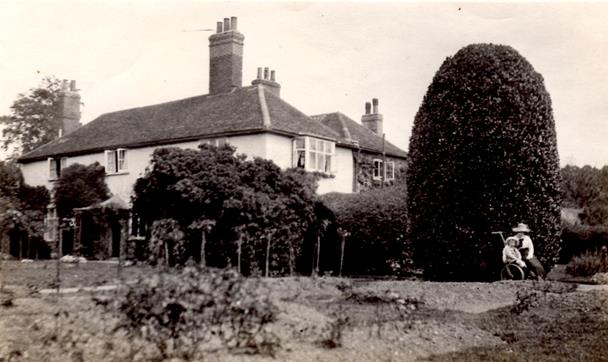
On 29 September 1910, Marion Mackenzie took out a seven-year lease on Home Farm Cottage, Livermere Road, Great Barton, for an annual rental of £71. The timber-framed 16th century house with mid-nineteenth century additions had 13 rooms. It was situated on the Barton Estate and overlooked Barton Park.
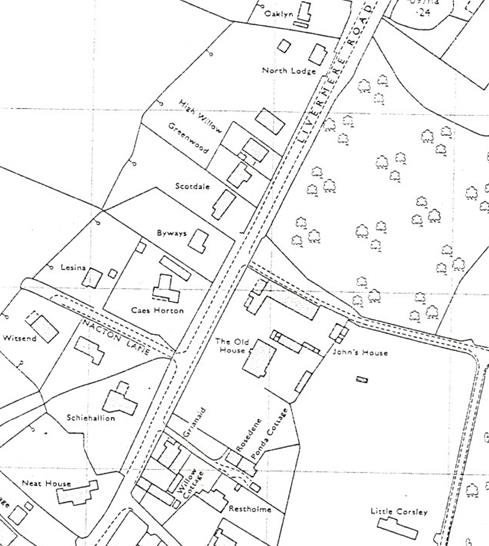
Marion did not move in to the house immediately and, in the 1911 census, Eric Morton Paget (1868- 24 February 1929) occupied Home Farm Cottage with his wife, Georgina Byng Paget (1874-1916), and a cook and parlour maid. Eric, who was born in Stuston, Suffolk, was a fruit farmer living on private means. He is listed in electoral registers in Tewkesbury from 1908 until 1920 and not in Great Barton, although Kelly’s Directory of Suffolk 1912 records him as living in Great Barton. Georgina Paget died at Hindhead, Surrey, on 14 September 1916.
In 1911, Lilias lodged at Bridge House, Great Blakenham, Suffolk, with her youngest son. Ernest. Stuart and Ethel lived in an eight-room house at Kelso, Holway Rd, Sheringham, Norfolk, with their son, Ian. I have been unable to find Marion or Sybil in the 1911 census.
In 1915, Home Farm Cottage was sold at auction following a fire on the night of 14 January 1914, which destroyed or damaged most of Barton Hall. The Barton Estate was sold in 100 lots at an auction on 15 and 16 July 1915 and Home Farm Cottage was sold as a freehold cottage to Marion Mackenzie and Harold D’Arcy Hutton (1872-1946).
In 1918 and 1919, Sybil was the only female service person on the electoral registers for Great Barton, listed alongside 55 servicemen in 1918 and 47 servicemen in 1919. Her address was given as Conyers Green. There is no indication of which service she was a member, but the possibilities include the Queen Alexandra’s Imperial Military Nursing Service, the First Aid Nursing Yeomanry, the Voluntary Aid Detachment or Queen Mary’s Army Auxiliary Corps. From 1920 onwards, Sybil was listed as an occupier elector (O) at this same address.
In 1918, Marion Mackenzie was listed on the electoral register in Great Barton as the joint tenant with Harold D’Arcy Hutton of a house on Conyers Green, which was presumably Home Farm Cottage, whose name was changed to The Old House. From 1918 onwards, Marion was listed as an occupier (O), Harold as a resident (R) and Lilias, whose name was incorrectly recorded as Sybil, as qualified though her husband’s occupation (HO).
The Old House was registered as a Grade II listed building on 28 March 1985.
In 1919, Sybil served on the committee which organised a day of celebrations in Great Barton for the returning soldiers. She helped to organise the sports afternoon, during which her mother presented a commemorating medal of the event to each of the 150 schoolchildren (Bury Free Press, 26 July 1919).
Sybil was an active church member and was elected to the Parochial Church Council of Holy Innocents’ Church, Great Barton in 1923 and as the lay representative of the Ruri-decanal Conference in 1925. At the AGM in 1926, the Vicar, the Revd. Hatt Lipscombe, eulogised her service and nominated her as a Church Warden, but she declined (Bury Free Press, 17 April 1926). By 1923, there was a great deal of criticism of the vicar and it was claimed that some Great Barton church members had chosen to attend a church in Bury St Edmunds and other had declined to become members of the Great Barton Parochial Church Council (Bury Free Press, 03 February 1923). In 1924, the vicar accused others of poisoning the village against him; a story that merited several columns in the local paper (Bury Free Press, 03 May 1924).
Sybil helped to raise money for various good causes. In 1921, she helped to organise a fete in the gardens of Great Barton Vicarage to raise money for Great Barton Elementary School and offered a prize to the person who could correctly guess the number of inhabitants of the parish (Bury Free Press, 16 July 1921). In 1922, she arranged a concert, which raised £8.13s. towards a new piano for the Church Institute (Bury Free Press, 23 December 1922).
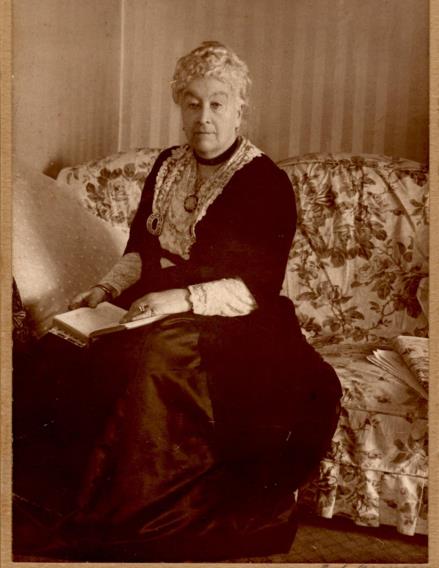
Sybil’s mother, Marion, died in Great Barton in 1923. She was described in her obituary as a ‘fine type of lady of the Victorian era, being true and loyal to her God, her church and her country’. The obituary mentions ‘her good works in the parish and especially in giving happiness and pleasure to the children of the parish.’ Many friends and family attended her funeral at Holy Innocents’ Church, Great Barton, and floral tributes included ones from Mary and Edward Snelling, her butler for 30 years, and from Nurse (Ada Bennett), ‘ in loving memory of a dear mistress’(Bury Free Press, 13 January 1923, p.2).
Sybil served on the Ladies’ Committee of Bury St Edmunds Hospital from 1923 onwards. She helped to arrange the annual balls at the Athenaeum in Bury St Edmunds, which raised funds for Bury St Edmund Hospital (Bury Free Press, 22 December 1923 / Bury Free Press, 13 June 1925). She also helped to organise summer fetes, served on the tea committee and gave assistance in the first aid tent (Bury Free Press, 09 August 1924).
In 1925, she was on the dancing class committee, which met regularly in the Church Institute and organised a range of events. When it organised a whist drive to raise money for Great Barton School, Sybil donated a prize (Bury Free Press, 25 April 1925). Members often made the tea at socials and held events to raise money for the annual church outing (Bury Free Press, 14 February 1925). In 1927, Sybil helped to organise a social, and provided the prizes to best costume maker (Bury Free Press, 05 March 1927).
She often took part in lawn tennis tournaments, partnering her brother-in-law, Harold, in the mixed doubles in 1921 (Bury Free Press, 30 July 1921) and a friend in the ladies’ doubles in 1928 (Bury Free Press, 4 August 1928).
In March 1925, she was nominated as a parish councillor and was elected with six men (Bury Free Press, 21 March 1925)
She was a member of the Women’s Section of the British Legion and local secretary of the Poppy Day Appeal from 1923 until at least 1936 (Bury Free Press, 13 October 1923 / Bury Free Press, 07 November, 1936).
She kept chickens, and donated eggs to West Suffolk Hospital. In 1923, she took 1,000 eggs, collected by the senior children at Great Barton School, to the hospital (Bury Free Press, 02 June 1923). In 1927, she advertised White Leghorn Pullets for Sale for 5s. each, which she claimed were ‘laying splendidly’ (Bury Free Press, 18 June 1927).
In 1935, she donated 5s. to the Mayor’s Christmas Relief Fund (Bury Free Press, 28 December 1935).
In 1936, she went to Tewkesbury, Gloucester, to attend the funeral of Ada Bennett, who had worked for Harold and Lilias for 32 years. Ada died whilst on a visit to Tewkesbury to stay with Lilias’ youngest son, Ernest, who was precentor of Tewkesbury Abbey.
Sybil moved to York Terrace, Sidmouth, Devon, (Birmingham Daily Post, 25 June 1954), never married, and outlived her sister and both brothers.
During the early 1950s, she lived with her nephew Ian Stuart Gruinard Mackenzie and his family at Finstall House, Finstall, Worcestershire.
In 1920, Ian Mackenzie worked as a cable operator for the Eastern Telegraph Company, which became one of the largest cable operating companies in the world, operating 160,000 nautical miles of cables at its peak. He sailed on the Khiva to Gibraltar on 2 July 1920 and worked in Egypt. He returned to the UK on the Majala on 14 August 1925 giving his address as 135, Fellows Road, Hampstead. In 1926, he sailed on the Rajputana to Port Said, Egypt, where he worked as a cable telegraphist. The Eastern Telegraph Company merged with other companies and became Cable and Wireless Ltd. in 1934. He married Maria Teresa Lucila Emily Albrines and had a son who died at the age of eight, possibly from pneumonia. During the Second World War, Ian served in the Royal Corps of Signals. He was awarded an MBE in the birthday honours list of 1944 when he was Temporary Major. He divorced Maria Teresa and several years later married Dorothy K. Lorimer in 1945.
Sybil died in All Saints Hospital, Bromsgrove, Worcestershire, leaving £16,792. 13s. 8d. (net £10,221. 16s.1d) (Bury Free Press, 02 July 1954), which was administered by Westminster Bank Limited and her nephew, Ian, who worked for the electricity board in 1954.
Ian became personnel manager at the Atomic Energy Authority at Harwell, where he remained until his retirement in 1967. He and Dorothy moved to Scotland, where Ian died in 1976. Dorothy moved to Canada in 1980 and died in Vancouver in 2006. They left two sons, Colin and David, who is the 10th of Gruinard, whose nickname for Sybil was ‘Moo’.
[i] http://www.fullbooks.com/History-Of-The-Mackenzies12.html
 BERTUNA'S CHILDREN