Harold Edward D’Arcy Hutton – background
John Timothy D’Arcy Hutton I (1822-1874) married Emma Rebecca Lamb (1818-1896) in 1844. They lived at Aldburgh Hall, north Yorkshire, and had two daughters and a son, John Timothy D’Arcy Hutton II (1848 – 4 Jan 1931), who was the father of Harold Edward D’Arcy Hutton. In 1861, they employed eight servants.
John Timothy D’Arcy Hutton II (5 Jan 1847- 4 Jan 1931) served in the Royal Dragoons and married Edith Constance Phipson (31 May 1849-11 April 1929) at Kensington in 1867. They remarried on 17 June 1868, in the parish church at Plumstead, the parish in which Edith had been born. Edith’s father, Thomas Barroll (3 December 1811 – 5 December 1865), was described on the marriage certificate as a ‘gentleman’.
John Timothy II and Edith lived at Frithelstock, Devon, and had five children. Their first child, John Timothy III (22 Feb 1869 – 10 April 1957) was born at Plumstead, Edith Flora (1870 – 21 February 1960), Harold Edward (1872-1946) and Hilda Winifred (1875-?) were born at Frithelstock, Devon, and their fifth child Aldyth Lorna (October 1877 – 30 June 1950) was born in Richmond, Surrey.
On the death of John Timothy I in 1874, John Timothy II inherited Marske Hall and Aldburgh Hall, both in north Yorkshire. In 1878, John Timothy II moved into Marske Hall with his family and, in 1881, were looked after by 13 servants, including a governess. John Timothy II was listed in the Deacon´s Court Guide, Gazetteer and County Blue 1883 as living at Marske Hall.
The names of John Timothy III and Harold Edward are ‘cut into the boards’ of Eton College, Berkshire: John in 1886 and Harold in 1887.
In April 1891, John Timothy II and Edith lived at Rose Cottage, in the grounds of Marske Hall, with their eldest son, John Timothy III, who was a second lieutenant in the Yorkshire Artillery. Marske Hall was occupied by six servants. In 1891, Harold, who was a second lieutenant in the Suffolk Artillery, was visiting the barracks in Bury Street, Ipswich. The three D’Arcy Hutton daughters were staying in Scarborough at 1, Albert House, Albion Road, visiting Arthur Smith, an auctioneer and house agent.
On 14 October 1897, Hilda Winifred married Edward Hyde Hamilton Gordon (8 Nov 1861- – 11 July 1955), who was descended from George Plantagenet, Duke of Clarence. Edward was born in Athlone, Ireland, married Cecilia Maude Manders (?-3 April 1893) on 4 January 1888 at Dublin and had one daughter, Estella Maude (1892-?), who was born in Newara Eluja, Sri Lanka. Four years after Maud’s death, Edward married Hilda and they had a daughter, Hermione Harriet (11 Sept 1898 – 1983), who was born at Aldburgh Hall. Between 1882 and 1893, Edward, who spoke French, served with the Gordon Highlanders in Malta, Egypt and Ceylon. On 8 January 1914, Hilda, Estella and Hermione were living at 17, Berkeley Street, Kensington, (next door to the Royal Palace Hotel), when Estella married Percy Lovell Clare Haslam, an officer with the 18th Hussars and son of a ‘gentleman’.
During the First World War, Edward served as a captain (1914), colonel and then major in the Labour Corps with the 9th Battalion of the Gordon Highlanders and awarded with a medal. Hilda and Edward divorced and Edith lived at Chertsey in 1933. Hermione was on the electoral register at Bramble Cottage, Newbury, Berks, from 1935 to 1955, On 21 November 1934, she sailed from Southampton to Malta on the Largs Bay and on 25 March 1950, sailed back from Durban, South Africa, to the UK on the Warwick Castle. In 1961, Edward died in Cape Town, South Africa, and Hermione, who never married, died 22 years later. There is a memorial to Hermione at Marske Hall.
In 1901, John Timothy II and Edith lived at Aldburgh Hall, with Edith, Aldyth and six servants.
Photograph of D’Arcy Hutton family, c 1902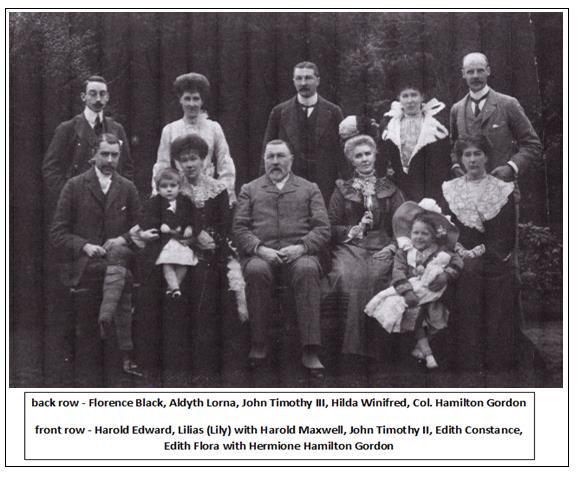 Aldyth Lorna married Florance William Black (31 Jan 1879 – 1938) on 16 May 1902 in the parish of St Margaret, Westminster. When he died at Burnham, Buckinghamshire, he left £9,219. 14s. 9d. in his will .
In 1911, John Timothy III was lodging at 26, Regent Street, Plumstead, and working as a barrister-at-law.
On 17 Jan 1917, John Timothy D’Arcy Hutton IIII married Ella Mary Bell (1881 – 24 January 1946), the daughter of a ‘hide factor’, at the church of St Mary the Virgin, West Derby, Liverpool. In 1923, they sent a wreath to the funeral of Marion Mackenzie, his brother Harold’s mother-in-law. In 1938, John Timothy III and Ella lived in Mill Lane, Hayman’s Green, West Derby, Liverpool (Kelly’s Directory of Liverpool and suburbs 1938). She died in 1960 leaving £37,081. 5.6d. to her husband.
Edith Flora never married. She was living at The Woodlands, 36 Mill Lane, West Derby, Liverpool, when she died leaving £170,503. 3d. to Norman Spencer Mumby and Wilfred James Thomas, chartered accountants.
Lilias Marion Louise Mackenzie – background
see Sybil Constance Alexandra Mackenzie (1872-1954)
Harold Edward D’Arcy Hutton and Lilias Marion Louise Mackenzie – family
On 1 March 1898, Harold Edward D’Arcy Hutton married Lilias Marion Louise Mackenzie (22 March 1869 – 18 April 1945), at Christ Church, Lancaster Gate, in the Bayswater district of central London.
They had three sons:-
- Harold Maxwell (7 April 1900 – 17 January 1971), born in Colombo, Sri Lanka,
- Derek Colville Conyers (4 June 1903 – 23 November 1968), born at 40, Queensborough Terrace, Paddington, the home of his maternal grandmother.
- Ernest Robert (14 April 1910-1964), born at The Grove, Stutton, Ipswich.
After their marriage, Harold and Lilias lived in Colombo, Ceylon (now Sri Lanka), where Harold worked as a tea planter. In 1901, they returned to the UK with Harold Maxwell on the Derbyshire from Colombo to London via South Africa and Plymouth. They had two more sons, born in London and Suffolk. The family employed Ada Annie Bennett (1875- 21 Nov 1936), who came from Southwold, Suffolk, in various capacities from 1904 until Ada’s death in 1936.
Harold was a general manager, and was initiated as a freemason into the Provincial Grand Lodge of Middlesex on 6 March 1910, but resigned in 1912.
In March 1911, he sailed as a tourist on the Royal Edward from Avonmouth to Halifax, Nova Scotia, Canada. In April 1911, Lilias was lodging with Ernest at Bridge House, Great Blakenham, near the village where she had grown up. Eleven-year-old Harold was at school in Wellingborough and eight-year-old Derek at Aldeburgh Lodge, a preparatory school in Aldeburgh, Suffolk.
On 17 August 1911, Lilias sailed with her three sons and Ada Bennett (described as a nurse) from Liverpool to Quebec on the Empress of Ireland. Harold sailed back with them from Boston, Massachusetts, on the Caronia and they landed in Liverpool on 9 October 1912.
On 4 April 1913, Harold, Lilias and Ernest sailed from Southampton to New York on the Oceanic, accompanied by Ada Bennett, who was now described as a lady’s maid. They stayed in Canada and sailed back from Quebec to Liverpool on the Empress of Britain on 11 September 1913. Harold sailed on his own on the Mauretania from Liverpool to New York on 13 March 1914, and Lilias sailed with Ernest on the Canada to Quebec on 5 July 1914.
In Canada, they stayed at Port Arthur, Ontario. This had been designated as a city in 1907 and was the Lake Superior headquarters for the Canadian Northern Railway from 1900. It is possible that Harold was there on business, since Port Arthur was trying to attract manufacturing industries to the town at that time.
On 6 October 1916, Harold was one of eight passengers on the Adriatic, which sailed from Liverpool to New York. He described himself as a tourist intending to travel to Vancouver. In 8 December 1916, he crossed the border from Canada to the United States at Buffalo and returned to the UK on the Finland on 25 December 1916.
Harold Edward and Lilias Marion Louise D’Arcy Hutton – Great Barton
By 1917, Harold and Lilias had moved to Great Barton to live with Lilias’s mother and sister, Sybil, at The Old House, Livermere Road.
In March 1917, Lilias was the registrar for Great Barton, responsible for keeping a register of women agricultural workers who could join the Women’s Land Army and help local farmers (Bury Free Press, 24 March 1917).
She was a member of the Red Cross Working Party in Great Barton, which met regularly at the Vicarage and sometimes at her home (Bury Free Press, 10 August 1918 / Bury Free Press, 22 February 1919).
In 1916, the Revd Hatt Lipscombe, vicar of Holy Innocents’ Church, Great Barton, nominated Harold as the vicar’s warden in place of Major Hugh Copinger Hill who was fighting overseas (Bury Free Press, 29 April 1916). In 1920, Harold and Archie Ainsworth Hunt distributed 40 half-crowns to widows and other deserving poor of the parish in accordance with the will of the Revd William Howerdly, Vicar of Holy Innocents’ in 1492 (Bury Free Press, 03 January 1920). In 1920, Harold was elected as the lay representative of the Ruri-decanal Conference (Bury Free Press, 08 May 1920).
In 1919, Harold chaired the committee set up to decide how the village should commemorate those men who were from, or associated with, Great Barton, who had died in the First World War (Bury Free Press, 13 December 1919 / Bury Free Press, 17 January 1920). At a public meeting in 1919, it was decided by 29 votes to six to erect two memorials; one inside and the other outside the church. Some members of the committee, including the vicar, claimed that it was a bogus majority, because some people had not been eligible to vote and some had voted twice. There were many subsequent arguments on the committee, where it was evident that Harold did not get on with the vicar or the head teacher of the village school and Harold resigned. The committee eventually agreed on the erection of a memorial in the churchyard and a brass plaque in the church (Bury Free Press, 24 April 1920).
In 1919, Harold attended a meeting of the Boy Scout Association, which hoped to set up more branches in the area (Bury Free Press, 12 April 1919). He was a member of Great Barton Working Men’s Club, which held whist drives, dances and meetings at the Church Institute, and he often donated and presented prizes (Bury Free Press, 21 February 1920 / Bury Free Press, 11 December 1920).
In 1921, Harold and Lilias served on a committee that organised a fete in gardens of Great Barton Vicarage to raise money for the schools. As one of the events, Harold buried gifts in the rose garden and visitors paid 6d. to find them. This fete made a profit of £35 (Bury Free Press, 16 July 1921).
Harold wrote a letter to the Bury Free Press complaining about the poor service and inferior rolling stock provided by Great Eastern Railway Company. He complained that the journey of two hours from Bury St Edmunds to London was too long. His letters prompted further correspondence in support of his complaint (Bury Free Press, 05 November 1921 / Bury Free Press, 26 November 1921).
By 1922, Harold had become a parish councillor, where he participated in discussions about the state of the well at Conyers Green and of School Lane (Bury Free Press, 22 April 1922).
Harold and Lilias kept chickens, white Anglo-Swiss goats (Bury Free Press, 09 September 1922) and dogs. In 1922, Lilias attended a meeting of the Royal Society for the Prevention of Cruelty to Animals at the Athenaeum (Bury Free Press, 16 December 1922). In 1923, she attended a meeting in Bury to discuss the revival of the Bury Dog Show (Bury Free Press, 24 March 1923). She entered her fox terrier in the Suffolk Kennel Association dog show at Ipswich (Bury Free Press, 24 May 1924) and the second Bury St Edmunds Dog Show (Bury Free Press, 26 July 1924). Lilias was one of the organisers of Bury Dog Show in 1926 (Bury Free Press, 18 September 1926, p.8). Harold enjoyed watching the Suffolk Hunt with foxhounds, which started from Angel Hill (Bury Free Press, 15 November 1924).
From 1923, Harold and Lilias attended the annual balls at the Athenaeum to raise funds for Bury St Edmund Hospital (Bury Free Press, 08 January 1925). In 1925, Harold donated two guineas to the hospital’s centenary fund (Bury Free Press, 09 May 1925). In 1927, Harold, Lilias and Sybil organised one of the competitions at the summer fete, held at Hardwick (Bury Free Press, 06 August 1927).
Both Lilias and Harold were active members of the Conservative and Unionist Party from 1924 onwards. Lilias was president of Great Barton Women’s Unionist Association and Harold was president of the local branch. In 1924, Harold was one of the nominees of the parliamentary candidacy of Walter Guinness who was opposed by the Liberal Party candidate, John Adam Day (Bury Free Press, 25 October 1924). Association meetings and concerts were held in the Church Institute and were usually well-attended (Bury Free Press, 28 June 1924 / Bury St Edmunds, 24 January 1925 / Bury Free Press, 31 October 1925).
Harold enjoyed sport. He played cricket, tennis (Bury Free Press, 08 August 1925), and golf (Bury Free Press, 22 April 1922). He was vice president of Great Barton Union Football Club, set up in 1924 (Bury Free Press, 05 January 1924) and he played a leading role in a fund-raising events for the club in 1925 (Bury Free Press, 07 November 1925).
Harold’s mother, Edith, died at Carlton Private Hotel at Bexhill-on-Sea, Sussex, on 11 April 1929. She left £1,246. 13. 5d. to her eldest son, John Timothy III, who was a barrister.
Harold’s father, John Timothy II of Marske Hall, died at the Granby Hotel, Harrogate, on 4 January 1931. He left probate of £219,199. 5s. 5d. (£54,427 net) to Charles Stewart Robson, Esq. and Sir Matthew Blayney Smith-Dodson, Bt. [(1856-Dec 1931), the 6th baronet of Newland Park, Yorkshire.] John Timothy II bequeathed £200 to Harold Edward and £1,500 and £500 to his grandsons Derek and Ernest (Yorkshire Evening Post, 21 April 1931).
In 1936, Lilias and Harold went to Tewkesbury with their son Harold and Lilias’s sister, Sybil, for the funeral of Ada Bennett, who had worked for their family for 32 years. Ada had been taken ill whilst on a visit to Ernest, who was a precentor at Tewkesbury Abbey. She spent three weeks in Tewkesbury Cottage Hospital and died on 21 November 1936 . Ernest officiated at the funeral in his capacity as precentor (Gloucestershire Echo, 24 November 1936, p 3). Ada left probate of £99.1s.5d. to Emily Jane Bennett (1887-1944)
There are no references to Harold or Lilias in the local newspapers between 1929 and 1935, when they donated a guinea to the Suffolk Regiment Chapel Fund (Bury Free Press, 16 March 1935) and a guinea to Bury St Edmunds Hospital in 1936 (Bury Free Press, 16 May 1936).
Harold Edward and Lilias Marion Louise D’Arcy Hutton – retirement
They were living on ‘private means’ at Seacroft East Cliff, Southwold, in 1939, and moved during the Second World War to 1, Coburg Terrace, Sidmouth, Devon, where Lilias died leaving £9,771. 1s. 4d. ).
Harold Edward D’Arcy Hutton died at 32, South Road, Hythe, on 19 February 1946, leaving effects of £5,807. 15s. 3d. to his eldest son Harold Maxwell and wife Minna.
 BERTUNA'S CHILDREN
2 thoughts on “Harold Edward D’Arcy Hutton (26 December 1872 – 19 February 1946) and Lilias Marion Louise Mackenzie (22 March 1869 – 18 April 1945)”